Leek
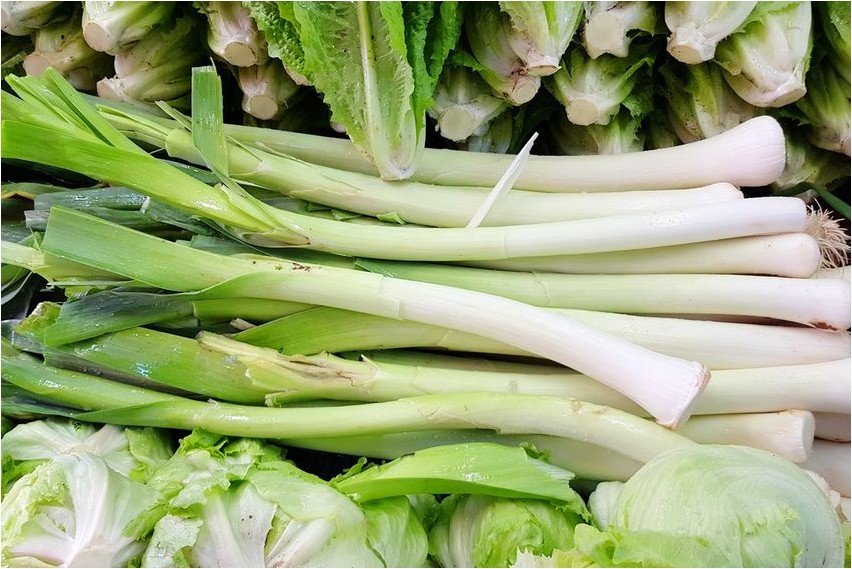
Leek (lat. Allium porrum) is a biennial plant of the Onion family. The homeland of leeks is the Mediterranean. Leeks were developed from the wild plant Allium ampeloprasum, common in the Mediterranean, Iran and England.
Currently, the crop is grown in large quantities in North Africa, America, France and other European countries.
Characteristics of culture
Leeks are one of the ancient and valuable crops. In the first year, the leek forms a powerful false bulb, consisting of thickened leaf bases attached to the bottom and smoothly turning into a false stem. The stem is green, under the leaves – white or light green, in cross section – white with a yellowish core. The leaves are flat, linear-lanceolate in shape, green in color with a waxy coating, arranged in the form of a fan, and have a central vein along the entire length.
In the second year of life, the plant forms a flower arrow, the height of which is about 1-2 m. The inflorescence is a spherical umbrella, initially covered with a sheath, reaching 6-8 cm in diameter. The flowers are small, white, pinkish or lilac in color. The seeds are triangular, black, wrinkled, and remain viable for 2-4 years.
Growing conditions

Leek is a light-loving crop; it grows and develops well in areas illuminated throughout the day. The preferred soils are light, moderately moist, fertile, loamy with a neutral pH. The optimal growing temperature is 20-25C. The best crop predecessors are tomatoes, cucumbers, potatoes, cabbage and legumes.
Growing seedlings and planting in open ground
Leeks are grown in seedlings and without seedlings. Before sowing, seeds are pickled in a weak solution of potassium permanganate. To speed up the process of germination, the seeds are germinated, placed on damp gauze, left for 2-3 days in a warm place, and then dried. Sowing is carried out at the end of February in seedling boxes filled with moistened soil. The seeding depth is 1-1. 5 cm.
After sowing, the substrate is watered with a spray bottle, covered with glass or film and placed in a room with an air temperature of 22-25 C. With the emergence of seedlings, the temperature is lowered to 15-17 C. After a week, the temperature is brought to 17-20C. Maintaining temperature conditions is extremely important for leeks. A month later, the seedlings are planted in separate containers, preferably in peat-humus pots. The seedlings are regularly watered and fed with liquid fertilizers.
Planting in open ground occurs when the seedlings are 6-8 weeks old. Before planting, harden off the seedlings. The plot for growing leeks is prepared in the fall. The soil is thoroughly tilled, and compost, superphosphate, and potassium chloride are added. In the spring, the beds are loosened with a rake. The roots of the plants are dipped in a clay slurry before planting. The holes should be approximately 10-13 cm deep. The distance between plants should be 15-20 cm, and between rows, 25-30 cm.
Care
Leeks are a rather demanding crop, requiring regular watering, fertilizing, weeding, and hilling. To provide a more comfortable environment for the plants and make work easier, the soil in the beds is mulched. When the leek stems reach 0. 5 cm in diameter, add soil to the holes and then regularly hill them. This process helps produce longer, more radiant stems.
This crop requires a lot of watering and fertilizing, especially during the first half of the growing season. Fertilizers best include mullein or bird droppings in a 1:8 and 1:20 ratio, respectively.
Harvesting
Leeks are harvested between August and October, depending on the variety. Carefully dig up the plants with a shovel, shake off the soil, and place them in wooden boxes. Leeks are stacked vertically or tied into small bundles. Store leeks in sand at a temperature of 0-1°C.
How to Grow HUGE LEEK? From Seed to Harvest in One Video.