Blue Quandong
Blue Quandong (Latin: Elaeocarpus angustifolius) is a fruit tree belonging to the rare Elaeocarpaceae family.
This tree is sometimes called the bead tree, blue fig, or blue marble tree.
Description
Blue Quandong is a fruit tree with a very dense, conical crown. In the wild, it can reach a height of thirty-six meters, but in cultivation, its height almost never exceeds six to seven meters. However, harvesting from taller trees is much more difficult.
The trunk diameter of mature trees can reach eighty centimeters, making blue quandong impossible to miss in picturesque tropical forests. These trees are also covered in striking grayish-white bark, which makes them stand out from other nearby trees. The glossy leaves of the blue quandong are dark green above and lighter beneath. The leaflets are grouped in small tufts at the ends of the shoots. They typically reach four to six centimeters in width and twelve to seventeen centimeters in length. Very young leaves boast a surprisingly pleasing red color with a magnificent bronze sheen.
The pink or white flowers are bell-shaped and appear along the branches where fallen leaves used to be. Their aroma is vaguely reminiscent of licorice, and the plant blooms from spring until early summer.
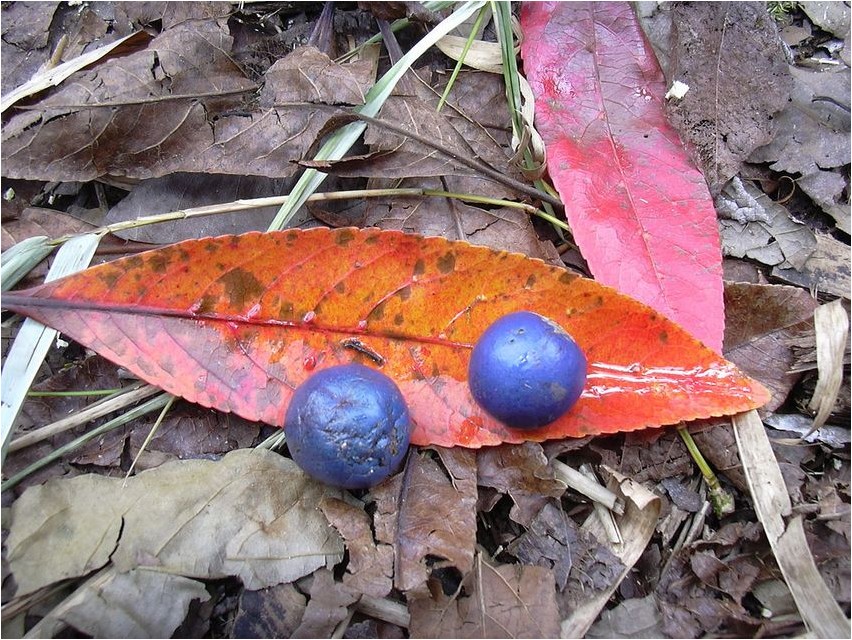
Blue quandong is characterized by abundant fruiting, with this plant producing a bountiful harvest every year. Its edible fruits are bright blue and reach two to three centimeters in diameter. Each fruit contains a single seed, enclosed in a very strong, deeply convoluted shell. These shells ensure that the seeds are never digested by the animals that eat the fruit, which significantly facilitates the plant”s further spread.

Where it grows
The blue quandong is considered native to Australia, specifically the states of New South Wales and Queensland. This plant can be found at altitudes of up to 1, 100 meters above sea level.
Uses
Blue quandong berries are bitter, so only Australian Aborigines eat them. Locals also often make a special paste, pie filling, or jam from these berries. Kangaroos are especially fond of them.
As for the seeds of the blue quandong, they are widely used in Aboriginal culture—they are used to make prayer beads, as well as attractive bracelets, necklaces, and many other ornaments.
The chemical composition of this crop has not yet been adequately studied, but it is believed that these berries are rich in tannins, B vitamins, various minerals, pectins, anthocyanins, organic acids, and ascorbic acid, which is essential for the body.
Contraindications
Since blue quandong berries contain a fairly high amount of organic acids, people with high stomach acidity should refrain from eating them. Individual intolerance is also possible. Growing and Care
Blue quandong is incredibly moisture- and heat-loving, and thrives best in swampy forest areas. Like all other tropical forest plants, it grows very quickly.
Berries You”ll See for the First Time
Blue quandong