Meadowsweet
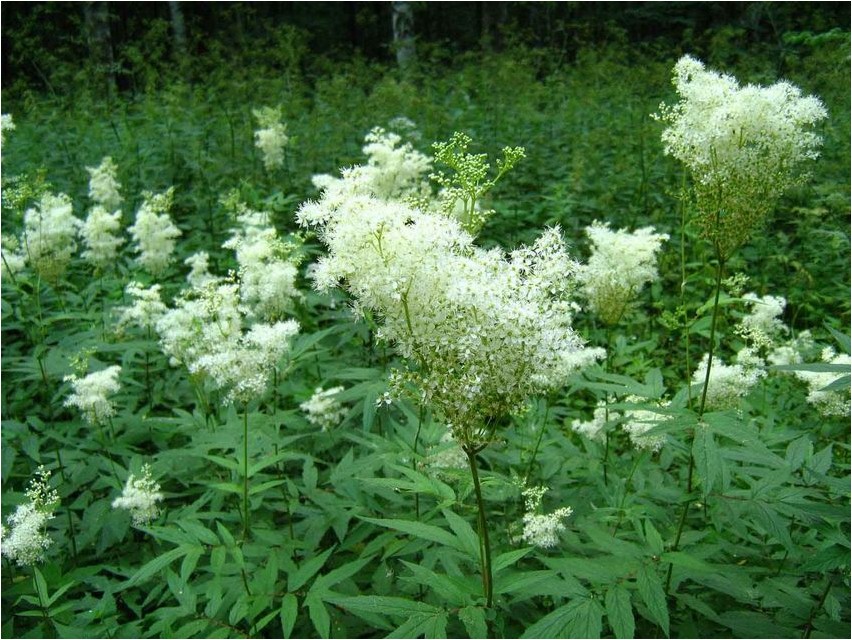
Meadowsweet is a member of the Rosaceae family. Its Latin name is Filipendula ulmaria (L.) Maxim.
The Latin name for the Meadowsweet family is Rosaceae Juss.
Description of Meadowsweet
Meadowsweet is also known as meadowsweet and elm-leaved meadowsweet. Meadowsweet is a perennial herbaceous plant, reaching heights between seventy and one hundred and twenty centimeters. Its stems are erect, glabrous, and quite sturdy. Its leaves are pinnate, with two to five pairs of incised-serrate, oblong-ovate leaflets. The leaves are green on top and white-tomentose underneath. Between the leaflets of this plant are small, doubly serrated intercalated lobes. The inflorescence of the meadowsweet is dense, reaching up to twenty centimeters in length, and is paniculate and multi-flowered. The flowers are small, white, pentamerous, and possess a highly fragrant aroma.
In the wild, this plant is found in Ukraine, the Caucasus, Moldova, European Russia, Belarus, Mongolia, Central Asia, and Western and Eastern Siberia. It is noteworthy that in North America, this plant can be found growing wild as an invasive plant. Meadowsweet prefers locations near springs, moist meadows in river valleys, and forest gorges with running water, located among thickets of fireweed, horsetail, and other moisture-loving grasses. It’s worth noting that this plant is not only a highly valuable honey plant, but also an ornamental one.
Description of the medicinal properties of meadowsweet
Meadowsweet is endowed with very valuable healing properties. The presence of such valuable medicinal properties should be explained by the fact that all parts of this plant contain tannins. During the period of formation of generative shoots there is a peak of the greatest accumulation of tannins. Meadowsweet seeds contain essential oil, while ascorbic acid will be present in the leaves. The herb of this plant will contain essential oil, which consists of traces of heliotropin, salicylic aldehyde, terpene and vanillin. The roots of meadowsweet contain the glucoside gaulterine and methyl salicylate. This plant also contains beta-carotene, chalcones, catechins, triterpene acids, glycerides, quercetin and quercetin 3-glucopyranoside.
The roots of this plant are used in homeopathy for various skin diseases, rheumatism and gout. As for the countries of Western Europe, a decoction prepared from the roots of meadowsweet is quite widespread here. This remedy is used as a diuretic, tonic and antihemorrhoid. A decoction of the roots and herbs of this plant is effective against dysentery. The plant has the ability to exhibit antiulcer activity, and is also used as a sedative. In Belarus, such healing agents are used for malignant tumors. It is noteworthy that the tannins contained in this plant will have a bactericidal effect.

A decoction of the roots, flowers and herbs of meadowsweet is used for epilepsy, gout, rheumatism, hemorrhoids, snake and rabid animal bites, and kidney and urinary tract diseases.
.