Gerbera
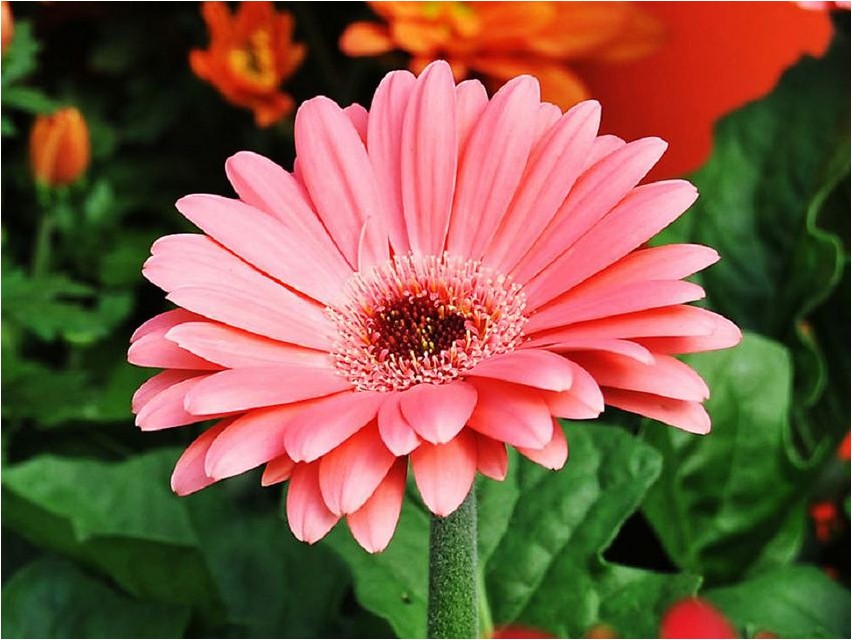
Gerbera is a genus that includes more than seventy species of plants in the Asteraceae family. Gerbera is native to the tropics and subtropics of Africa.
General characteristics
Gerberas are perennial herbaceous plants. The gerbera peduncle (leafless) grows up to 60 centimeters. The flowers have oblong leaves that reach thirty-five centimeters in length. They are collected in a basal rosette. Flower baskets are pleasing to the eye, they are quite large, they can be simple, and in some varieties they are semi-double. They reach a diameter of fifteen centimeters. The fruit of a gerbera is an achene.
Mainly varieties of the Gerbera jamesonii species are grown indoors.
Rules of care
Lighting. Gerbera is one of the light-loving plants. A little direct sunlight will not do any harm. The best place to grow gerberas is on western and eastern windows. If the only option is to place the flowerpot on a south-facing window sill, in the summer, take care to shade the plant – especially at noon. In the north, the plant may experience a lack of light. With the arrival of summer, it is recommended to provide the plant with fresh air, for which it does not hurt to take it out onto the balcony, protecting it from direct rays of the sun. You should carefully accustom your gerbera to new lighting conditions. Taking precautions will help you avoid unwanted sunburn. You should also take care of the proper level of lighting in winter by installing additional lighting using fluorescent lamps.

Temperature . Gerbera loves not only light, but also elevated temperatures. In winter, the optimal temperature is 14-15°C (it should not be allowed below 12°C). In spring and summer, the temperature should not fall below twenty degrees. More optimal conditions are 22-24°C. During gerbera flowering, it is extremely important to avoid significant differences between day and night temperatures. Such differences have an extremely negative effect on the decorativeness of flowers.
Watering. During the growing season, gerberas require moderate watering. For irrigation, it is important to use warm water, avoiding a significant difference between the temperature of the soil and water. This may cause the gerbera to become sick. Water when the top layer of soil dries out. The water must be settled. It is necessary to water extremely carefully during the dormant period. However, the soil should not be allowed to remain dry for a long time. It is necessary to water so that drops of water do not fall on the rosette of leaves. Because of this, the plant may begin to rot. Excessive watering should be avoided, which can provoke the development of various diseases and death of the plant.
Humidity . Gerbera thrives in high humidity. Although spraying is not a suitable maintenance procedure. It is recommended to spray, but moisture should not get on the plant. To increase air humidity, you can place the plant on a tray with pebbles or wet expanded clay.
Bloom. A distinctive feature of gerbera is that flowering is determined by the length of daylight hours. Gerbera produces flowers when daylight hours are shortened, that is, from August to September.
Feeding. Gerbera needs feeding, which is carried out with complex mineral fertilizers during the active growing season. Additional fertilizing using, for example, magnesium sulfate is welcome. If the temperature is low, care should be taken to add phosphorus. With the onset of winter, fertilizing should be stopped.
Transplant. Gerbera transplants are carried out in the spring, when the need arises. It is recommended to use soils that have a light mechanical composition. In this case, it is necessary to be vigilant about the acidity of the soil. For gerbera it should be at a pH level of 5-6. Any deviations are detrimental to your gerbera. You should also take care of drainage at the bottom of the pot. It is important to protect the outlet from the substrate.
Gerbera is propagated by seeds and dividing the bush. Division preserves the characteristics of the mother plant. Gerberas are divided in the spring, and the plant should not be less than three years old. During this process, two or three growing points are maintained on each cutting. New flowers should be expected next year.
Seed propagation is accompanied by a significant variation in characteristics. The seeds are sown in the spring, for which they take a nutritious and loose substrate. The use of the following mixture is encouraged: two parts turf and one part each of leaf and humus soil. It is also recommended to add a little sand to this mixture. The first picking occurs in the phase of 2-3 true leaves, the second is carried out in separate pots in the phase of 5 true leaves. A month after the plants have been planted in individual containers, it is recommended to carry out the first fertilizing. For this purpose, complex mineral fertilizer is used.
Possible problems
Overwatering is extremely dangerous for gerberas, so you need to water the plant carefully. This is especially true for the rest period in cool conditions.
If your gerbera leaves start to fade, the problem may be too much light. You should know that gerberas need shade from direct sun, in particular at midday. This needs to be done from spring until autumn.
High air humidity and insufficient ventilation lead to the development of fungus.
Deterioration in appearance, fading and elongation indicate that the gerbera suffers from a lack of light. This is also a characteristic sign of adaptation to indoor living.