Artemisia santolinifolia
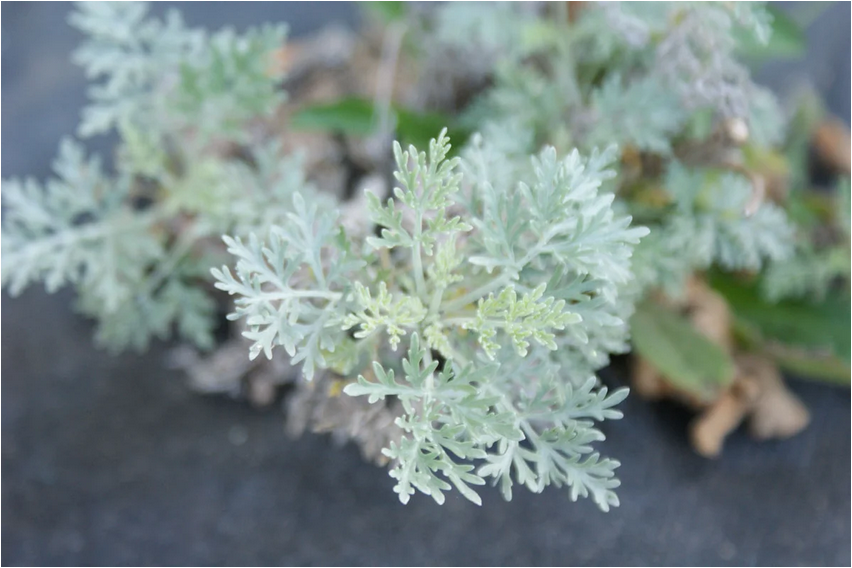
Artemisia santolinifolia is a member of the Asteraceae or Compositae family. Its Latin name is Artemfeia santolinifolia Turcz. ex Krasch.
As for the family name of Artemisia santolinifolia, its Latin name is Asteraceae Dumort. (Compositae Giseke).
Description of Artemisia santolinifolia
Artemisia santolinifolia is a subshrub, reaching a height of between fifteen and eighty centimeters. The rootstock is woody, rather thick and vertical, and develops shortened, more or less upward-facing woody shoots that are perennial and clad in white, peeling bark. It’s worth noting that the leaves of Artemisia santolinifolia vary in size. The flower heads of this plant can be either sessile or stalked, reaching up to five millimeters in length. They will contain three to four flowers and are arranged in a loose paniculate inflorescence.
Artemisia santolifolia blooms in August. In the wild, this plant is found in Central Asia, the European part of Russia, the Volga-Kama region of the Southern Urals, the Altai region of Western Siberia, and the Daurian and Angara-Sayan regions of Eastern Siberia. It prefers rocky areas, rocky steppes, sparse deciduous forests, dry riverbeds and streams, steppe meadows, forest edges, shrubs, rocky, steppe, and gravelly slopes up to the upper mountain belt. Description of the medicinal properties of Artemisia santolifolia
Artemisia santolifolia has very valuable medicinal properties, and it is recommended to use the herb of this plant for medicinal purposes. The herb includes the leaves, inflorescences, and stems. This medicinal raw material should be harvested throughout the plant’s flowering period.
The presence of such valuable healing properties should be explained by the content of the phenolic compound xanthoxyline, essential oil and the following sesquiterpenoids in this plant: mucomycin, arsanine, artesine and arsantine. It is noteworthy that the essential oil of Artemisia santolinofolia will be endowed with fungicidal activity. The experiment proved that this plant exhibits sedative and antispasmodic effects, and can also be used as a cardiotonic. In addition, some components of this plant exhibit herbicidal and fungicidal activity.
For respiratory infections and gastritis, it is recommended to use the following very effective remedy based on this plant: to prepare such a healing remedy, you will need to take one tablespoon of crushed shoots of wormwood santolinophyllum per one glass of boiling water. The resulting healing mixture should be infused for about two to three hours, and then it should be filtered very carefully. The resulting product is based on wormwood santolinofolia three times a day, one-third or one-fourth of a glass.

For flatulence, it is recommended to use the following very effective remedy based on this plant: to prepare such a healing remedy, you will need to take one teaspoon of wormwood santolinofolia seeds per glass of boiling water. The resulting mixture should be infused for about two to three hours, and then this mixture should be filtered very carefully. Take the resulting healing remedy based on wormwood santolinofolia three times a day, one or two tablespoons.
About healing wormwood, St. John’s wort oil, pine cones and “flowers”, pine elixir





