Touch-me-not (Cordamine Impatiens)
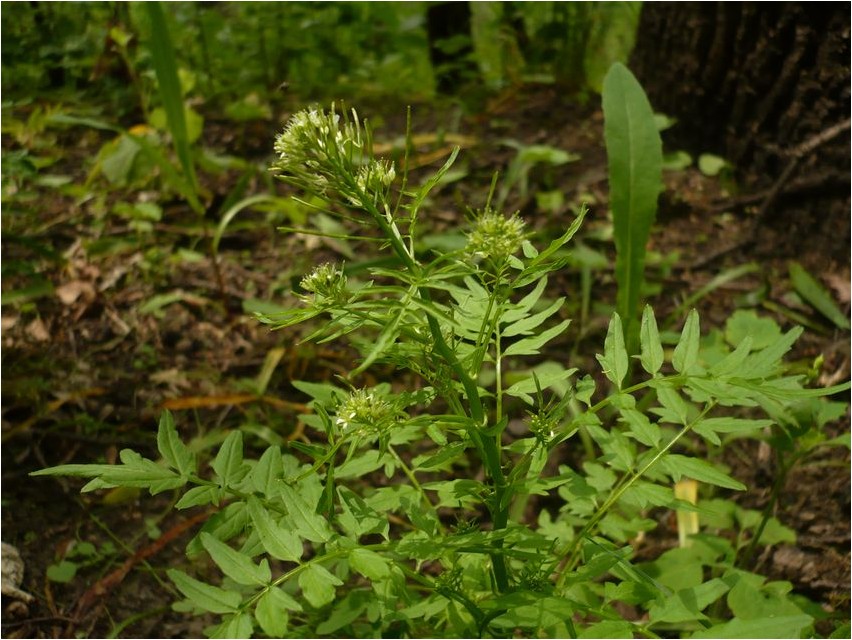
Touch-me-not (Cordamine Impatiens) is a member of the Brassicaceae or Cruciferae family. Its Latin name is Cordamine impatiens L.
The Latin name of the touch-me-not family is Brassicaceae Burnett (Cruciferae Juss.).
Description of Touch-me-not
Touch-me-not (Cordamine Impatiens) is an annual, biennial, or perennial herbaceous plant, reaching heights between fifteen and eighty centimeters. Its stem is glabrous, and its leaves are either sparsely ciliated or glabrous. The leaf rosettes of touch-me-not (Cordamine Impatiens) are two- to four-paired, with the upper leaves bearing sessile, lanceolate leaflets. The flowers of this plant are very small, often lacking a corolla, and the sepals are up to 175 millimeters long. The petals of the touch-me-not are 2. 5 millimeters long, white, and oblong-cuneate.
In the wild, this plant is found in Ukraine, Central Asia, the Caucasus, European Russia, Belarus, and Western and Eastern Siberia. Touch-me-not prefers shady and moist forests, riverbanks and stream banks, and clayey and gravelly slopes up to the mid-mountain zone.
Description of the medicinal properties of touch-me-not
The touch-me-not has very valuable medicinal properties, and its leaves, flowers, grass, and seeds are recommended for medicinal purposes. The presence of such valuable medicinal properties can be attributed to the flavonoid glycosides quercetin and kaempferol, as well as traces of alkaloids, found in the above-ground parts of the plant. The leaves also contain ascorbic acid. The seeds of this plant contain fatty oil, which in turn contains the following acids: arachidic, linoleic, erucic, linolenic, oleic, palmitic, stearic, behenic, eicosadienoic, and dihydroxy acids.
An infusion made from the plant has a very effective diuretic and stimulating effect.

In the Caucasus, for convulsions in children, it is recommended to use an infusion based on the flowers of this plant. As for traditional medicine, the impatiens core has become quite widespread. A decoction prepared from the seeds of this plant can successfully replace mustard and is also used as a diuretic. It is noteworthy that the leaves of the impatiens core are perfectly acceptable to eat and can also be used as very effective antiscorbutic agents.
For convulsions in children, it is recommended to use the following healing remedy based on this plant: to prepare such a healing remedy, you will need to take one teaspoon of impatiens flowers per glass of boiling water. It is recommended to first leave the resulting medicinal mixture to infuse for about thirty to forty minutes, after which this mixture based on the impatiens core should be filtered very carefully. Take the resulting medicine based on this plant once or twice a day, regardless of food intake, one tablespoon.
The following remedy is used as a diuretic: to prepare it, take a teaspoon of impatiens core seeds in a glass of water. The resulting medicinal mixture should first be boiled for five minutes, left to infuse for an hour, and then filtered very carefully. Take this remedy three times a day, one tablespoon.