Allamanda
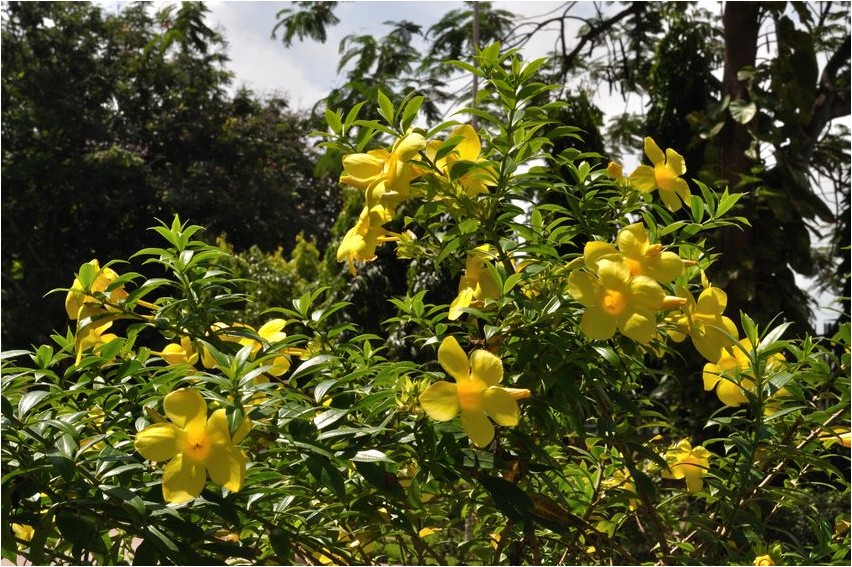
Allamanda (lat. Allamanda) is a genus of evergreen plants native to the tropics, stretching from Mexico to Argentina.
Among the representatives of the genus there are shrubs, vines and trees, distinguished by beautiful flowering. A member of the Kutrovaceae family, like many of their relatives, plants of the Allamanda genus contain white latex (sap), which can cause not only irritation on human skin, but also much worse consequences when in contact with it. Therefore, when caring for the plant, you should use protective equipment.
What”s in your name
This feminine genus name preserves the memory of a man, a Swiss doctor and botanist named Frederic-Louis Allamand, who lived and worked in the 18th century.
Description
The oval-pointed leaves of Allamanda are located opposite on the stem. The leaves are leathery, like many tropical plants, with a glossy surface or slightly pubescent. The shine or pubescence helps the plant retain moisture rather than allowing the sun to draw it into the sky. The edge of the sheet is smooth.
In photographs of the blooming Allamanda, it can easily be confused with the flowering plant “Tekoma”, whose inflorescences are also collected from yellow funnel-shaped flowers. But, looking closely at the leaves, it immediately becomes clear which plant was captured in the photo. After all, Tecoma’s leaf edge is decorated with clearly defined teeth, and the surface is not glossy.
Yes, and the yellow flowers of Allamanda are much larger (up to 14 cm in diameter) than those of Tecoma, but this cannot be seen in every photograph. Allamanda”s funnel-shaped flowers have five yellow or pink petals and form inflorescences that botanists call a “complex umbrella.”

The fruit of the plant is a spiny capsule that looks like a miniature hedgehog. There are seeds inside the box.
Varieties
The Allamanda genus, according to various sources, numbers from 12 to 15 plant species.
Let”s list a few of them:
* Allamanda angustifolia (lat. Allamanda angustifolia)
* Allamanda latifolia (lat. Allamanda latifolia)
* Allamanda neriifolia (lat. Allamanda neriifolia)
* Allamanda cathartica (lat. Allamanda cathartica)
* Allamanda Schottii (lat. Allamanda schottii)
Growing
Allamanda is a fast growing plant. Lianas, for example, grow up to three meters in length per year.
In the wild, Allamanda chooses places to live along river banks, or others open to the sun, but with moist, fertile soil and sufficient rain. In Australia, in the second largest state of Queensland, famous for its tropical natural reserves, Allamanda has become an aggressor, growing in landfills, in abandoned yards, and in roadside ditches. Simply pruning the plant right to the root has no effect, since it only stimulates the appearance of new growth from the roots remaining in the soil.
Shaded places are not suitable for the plant, as are alkaline or salty soils.
Allamanda is a heat-loving plant; frost kills it. Therefore, her fans living in areas with cold climates grow Allamanda in flower pots, which are placed in greenhouses, conservatories, residential or office premises.
The plant is propagated by cuttings.
Use in medicine
Allamanda laxative is used to treat malaria, jaundice, and liver tumors.
Laboratory analyzes of the chemical composition of Allamanda Schott”s tissues revealed the presence of active substances in the plant that have anti-inflammatory properties.
Some plant species have shown certain activity against pathogenic fungi, cell cancer, and HIV.