Amorpha
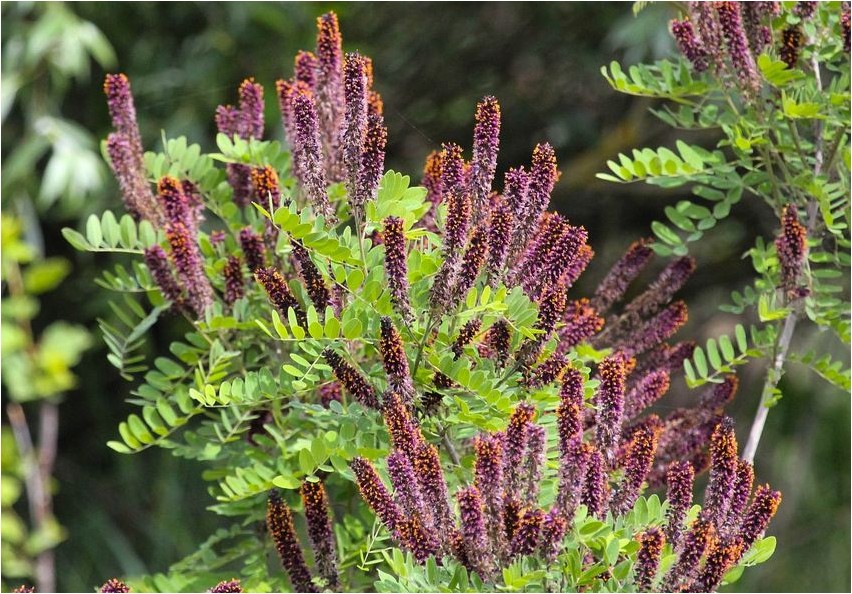
Amorpha (lat. Amorpha) is a genus of deciduous subshrubs or shrubs of the Legume family. Its natural range is southern Canada, northern Mexico and most of the United States.
The name of the culture comes from the Greek word “amorphos”, which translated into Russian means “shapeless, ugly,” which indicates the atypical structure of small purple or violet flowers. The genus contains about 15 species.
Characteristics of culture
Amorpha is a deciduous dense shrub or subshrub up to 2 m high with numerous twig-like ascending shoots of light brown-olive color. The leaves are compound, pastel-green, odd-pinnate, sessile or short-petiolate, pubescent or glabrous, up to 30 cm long, consisting of 11-25 oval leaflets of regular shape. The flowers are small, from white to dark purple, collected in narrow multi-flowered racemes, pyramidal or paniculate inflorescences. The calyx is bell-shaped, glandular-renal, equipped with five short teeth of the same or different sizes.
The fruit is a bean, contains one seed, does not open, and has glandular warts. The seeds are smooth, kidney-shaped, shiny. Plants do not have cold-resistant properties; only two species can boast of winter hardiness — dwarf amorpha and shrubby amorpha. Amorphous fruits contain essential oils that have antiseptic properties. Amorpha blooms in June — July for a month. Flowering is abundant and noticeable.
Growing conditions
Amorpha is a light-loving plant, develops fully and blooms profusely in well-lit areas, but easily tolerates side shading. The crop is not demanding on soils and can grow on heavy soils. However, light, sandy, moderately moist soils with a slightly acidic or neutral pH are optimal. The culture does not accept clayey, waterlogged, saline and swampy soils. Amorphous has a negative attitude towards thickening and requires regular thinning. The optimal temperature is 20-25C. Winter temperatures are not lower tha n-15C.
Reproduction and planting

Amorpha is propagated by seeds, layering, dividing the bush, cuttings and root shoots. The seeds are sown along with the fruit after soaking for twelve hours in warm water, which is changed from time to time. Favorable time for planting is early spring. In order to speed up the process of seed germination, preliminary stratification can be carried out, lasting about two months. In this case, seed germination exceeds 50%. Reproduction by layering and root shoots is more effective; this procedure is carried out in the spring.
Propagation by green cuttings, as a rule, gives 90% rooting. In the first year of growth, young specimens are brought into the basement for the winter, so it is more advisable to plant the material in pots or any other containers. Plants are not able to cope with wintering; low temperatures have a detrimental effect on the growth of amorpha. It is advisable to lime the area for cultivation and feed it with modern microbiological fertilizers. Nitrogen fertilizers should not be used since amorpha is a nitrogen-fixing plant.
Care
Under natural conditions, amorpha grows in damp places, so watering must be carried out regularly and abundantly, especially during prolonged drought. Drying out and waterlogging of the tree trunk zone should not be allowed. In August, watering is stopped, otherwise the shoots will not have time to prepare for winter. In regions with cold climates, plants freeze slightly, primarily in annual shoots.
Under the influence of low temperatures they freeze out. To prevent this from happening, the soil in the stem zone is mulched with a thick layer of peat or humus, and the shoots are bent to the ground and covered. Amorpha needs systematic weeding and loosening, both procedures are carried out simultaneously. The crop will not refuse mineral supplements either. Amorphs have a positive attitude towards pruning, which can give plants a beautiful decorative look. Amorphs that stand alone are only slightly trimmed, giving the plant silhouettes smoother shapes.