Buttercup is close
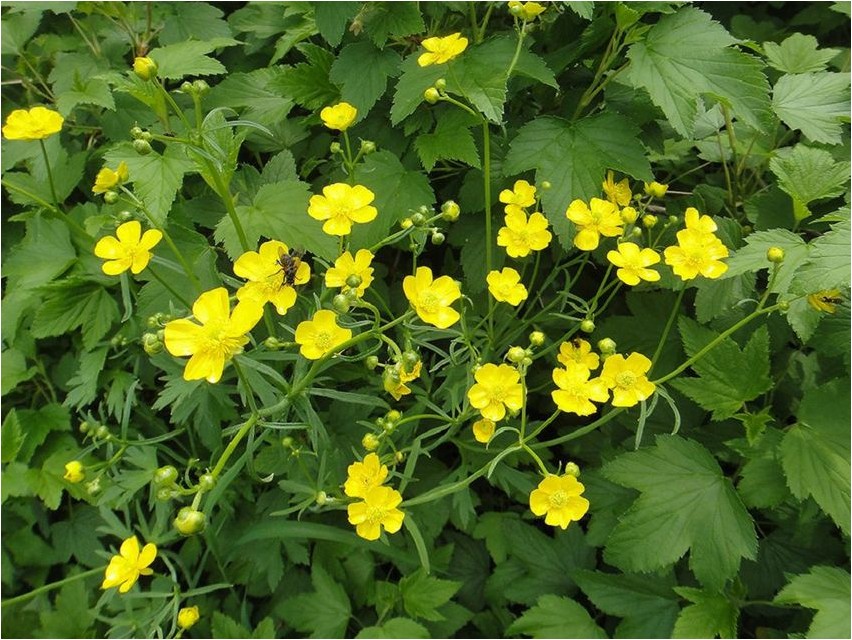
Buttercup is one of the plants of the family called Ranunculaceae; in Latin the name of this plant will be as follows: Ranunculus propinquus S. A. May.
As for the name of the close buttercup family itself, in Latin it will be: Ranunculaceae Juss.
Description of buttercup close
Buttercup close is a perennial herbaceous plant, the height of which will fluctuate between eight and thirty centimeters. The roots of this plant will be fibrous, and they are collected in a bunch. The stems of buttercup close are either simple or short-branched at the very top, and for the most part such stems will be single-flowered. The leaves on top can be either bare or almost bare, and the leaves of this plant are colored in light green tones. The basal leaves of buttercup close are petiolate and deeply tripartite, the stem leaves will be few and sessile, they are palmately divided into three to five segments. The flowers are about two and a half centimeters in diameter and are painted in golden tones. The sepals of the buttercup are protruding, oblong-ovate, and they are very densely covered with drooping hairs. These flowers have only five to eight petals; they are obovate.
Flowering of the buttercup occurs in the period starting from June and ending with the month of July. Under natural conditions, this plant is found in the Altai, as well as the Daursky and Angara-Sayan regions of Eastern Siberia. For growth, this plant prefers mixed and coniferous forests, high-mountain meadows, places along the banks of rivers in the forest zone, while the close buttercup will rise up to the upper mountain zone.
Description of the medicinal properties of buttercup
The buttercup is endowed with very valuable healing properties, and it is recommended to use the herb of this plant for medicinal purposes. The concept of grass includes the leaves, stems and flowers of the buttercup close.
The presence of such valuable healing properties should be explained by the content of protoanemonin in this plant. It is noteworthy that buttercup is a poisonous plant; for this reason, strict care should be taken when handling this plant in any way.

As for Tibetan medicine, here this plant is quite widespread. Buttercup is recommended for use for ascites, edema, headaches, chronic gastroenteritis, various female diseases and dizziness. In Siberia, this plant is used as an insecticide.
For dizziness, it is recommended to use the following medicinal remedy based on this plant: to prepare such a medicinal remedy, you will need to take half a teaspoon of dry crushed buttercup herb to about half a liter of boiling water. It is recommended to infuse the resulting healing mixture for about thirty to forty minutes, after which such a healing mixture should be filtered very carefully. Take the resulting very effective medicinal product based on buttercup two to three times a day, one teaspoon.
It is recommended to use the following healing agent as an insecticide: to prepare such a remedy you will need to take five tablespoons of buttercup herb per liter of boiling water. The resulting mixture should be infused for one hour, and then this healing mixture is filtered very carefully. To maintain effectiveness when taking such a remedy, you must follow not only all the preparation rules, but also follow all the rules for taking this remedy based on buttercup.





