Chinese hibiscus
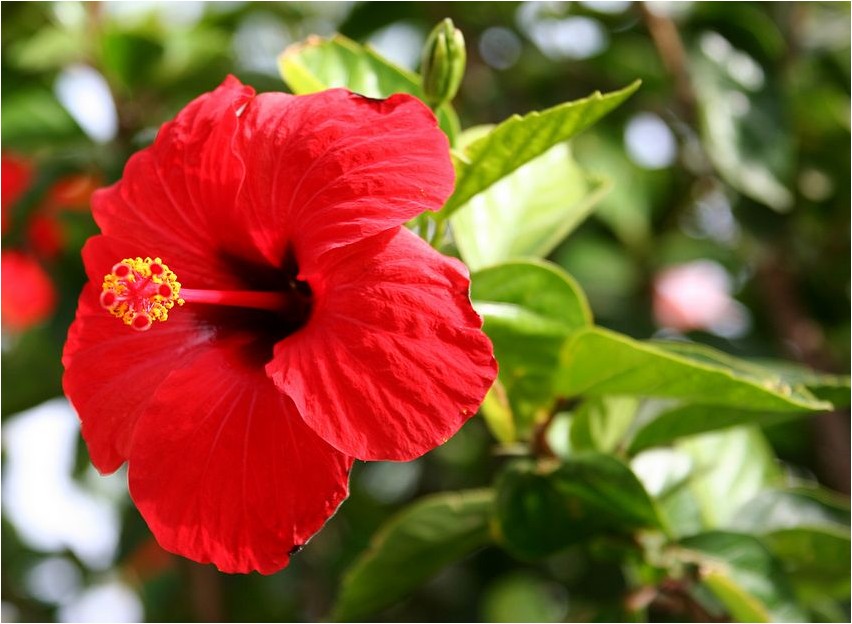
Chinese hibiscus is also known as Chinese rose; in Latin the name of this plant is as follows: Hibiscus rosa-chinensis. Chinese hibiscus is one of the plants of the family called malvaceae, in Latin the name of this family will be: Malvaceae.
Description of Chinese hibiscus
In order for the plant to develop favorably, it is necessary to maintain a sunny light regime or a partial shade regime. Throughout the entire summer period, watering should be plentiful, and air humidity should remain average. The life form of Chinese hibiscus is an evergreen shrub.
This plant is recommended to be grown in spacious and bright rooms, as well as in general purpose premises: offices and hallways. In addition, Chinese hibiscus is also quite often found in winter gardens. As for the maximum size in cultivation, the height of this plant can be about four and a half meters.
Description of the features of caring for and growing Chinese hibiscus
It should be noted that Chinese hibiscus is especially loved by gardeners for the reason that its cultivation does not require the creation of particularly difficult conditions. Until the plant reaches three years of age, Chinese hibiscus should be replanted every year. Such a transplant should be done either before or after flowering.
As for replanting adult plants, this should be done as needed. This will require either very spacious pots or tubs. In addition, instead of such a transplant, you can simply replace the top layer of soil by about five centimeters every year. Chinese hibiscus will require the following soil soil: four parts turf soil, one part sand and six parts leaf soil. The acidity of such soil can be either neutral or slightly acidic.
It is important to remember that if there is insufficient lighting, the flowering of this plant will be quite poor. It is also not recommended to suddenly change the growing conditions of this plant, and overdrying of the soil can cause the buds to fall off. In some cases, Chinese hibiscus can be damaged by aphids, whiteflies and spider mites. In the event that there is a sharp decrease in temperature, Chinese hibiscus can be affected by gray rot.

Throughout the entire period of active growth, it is important to maintain the temperature in the range between twenty and twenty-five degrees Celsius. As for the rest period, in this case the optimal temperature will be about sixteen to eighteen degrees. Chinese hibiscus requires moderate watering, and air humidity should also be average. It should be noted that in indoor conditions such a period of rest is forced: it begins in October and continues until February. The reasons for this period are insufficient air humidity and low lighting.
Chinese hibiscus is rarely propagated using seeds; propagation by layering is most often chosen. In addition, propagation is also possible using cuttings, which must be annual: this method is recommended to be used in July or August.
Regular fertilizing with phosphorus-containing fertilizers will make Chinese hibiscus bloom more abundantly. The plant will require formative pruning: in the spring, the shoots are shortened by one third of their length, and in the summer, it is important to pinch the branches, which grow quite quickly. Both the leaves and flowers of Chinese hibiscus have decorative properties.