Gentian bitter
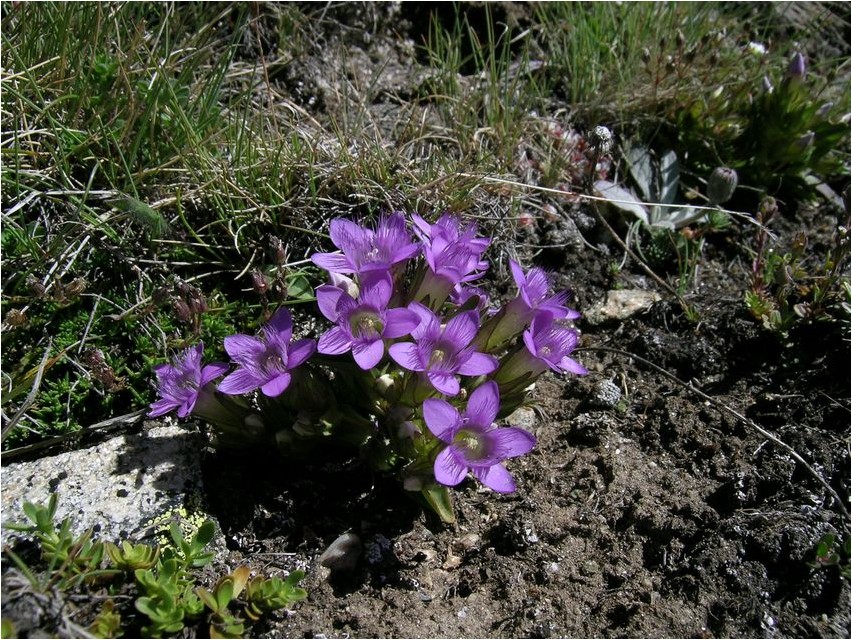
The bitter gentian is one of the plants of the family called Gentianaceae; in Latin the name of this plant will be as follows: Gentianella amarella (L.).
As for the name of the bitter gentian family itself, in Latin it will be like this: Gentianaceae Juss.
Description of bitter gentian
Gentian is a biennial herbaceous plant whose height can vary between three and sixty centimeters. The stem of this plant is straight and branched, sometimes it is simple. This stem will consist of six to twelve internodes. The leaves of the basal rosette are spatulate, while the lower and middle stem leaves will be either lanceolate or ovate-lanceolate, these leaves will also be sharp, their length will be about twenty to thirty millimeters, and their width will be about five to ten millimeters. In this case, the upper leaves of bitter gentian will be lanceolate and sharp. The corolla of this plant is tubular, and in color it will be either whitish or dirty purple, the length of this corolla will be about twelve to twenty millimeters. The blades of such a corolla are oblong and pointed, and their length does not exceed four to five millimeters.
Flowering of bitter gentian occurs in the period from July to October. Under natural conditions, this plant can be found in the European part of Russia, in the Yenisei region of Western and Eastern Siberia, in the Caucasus, in the European Arctic, as well as in Ukraine: the Carpathians and the Dnieper region. For growth, this plant prefers edges, forest glades, meadows, shrubs, limestone outcrops up to the upper mountain zone.
Description of the medicinal properties of bitter gentian
Bitter gentian is endowed with very valuable healing properties, and it is recommended to use the herb and roots of this plant for medicinal purposes. The presence of such valuable medicinal properties is explained by the content of flavonoids and alkaloids in the plant. It should be noted that tea and decoction of the roots of this plant is an excellent remedy that can stimulate appetite and improve digestion.
It is noteworthy that the infusion and decoction prepared on the basis of the gentian herb have found use in folk medicine for epigastric pain, and external use of such drugs is possible for abscesses. As for veterinary medicine, preparations based on this plant are quite effective for treating cough in horses.

For insomnia, it is recommended to use the following remedy: to prepare it you will need to take two teaspoons of bitter gentian roots in half a liter of water. the resulting mixture should be boiled for about three to four minutes, then the mixture is infused for one hour, after which the mixture is carefully filtered. This remedy, based on bitter gentian, should be taken one glass in slow sips about two to three times a day, warm.
For gastritis and epigastric pain, it is recommended to use the following remedy, which is considered very effective: to prepare such a remedy you will need to take one tablespoon of dry crushed bitter gentian herb per glass of boiling water. This mixture should be infused for one hour, and then it is very important to carefully strain the resulting mixture. It is recommended to take approximately two to three tablespoons of this remedy before meals. Provided that all these rules are followed, such a remedy will be very effective.





