Chickweed lanceolate
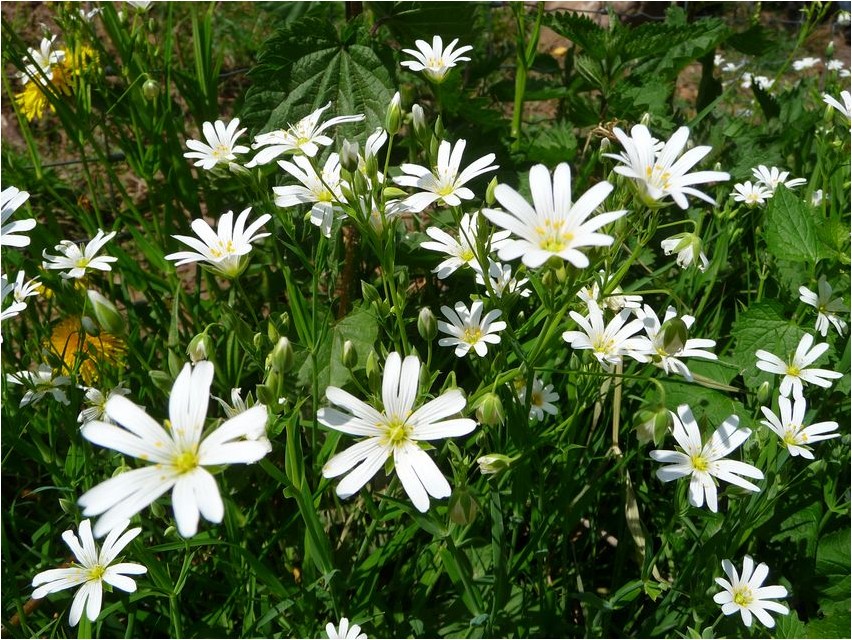
Chickweed is one of the plants of the family called Cloveaceae; in Latin the name of this plant will be as follows: Stellaria holostea L.
As for the name of the chickweed family itself, in Latin it will be: Caryophyllaceae Juss.
Description of chickweed lanceolate
Chickweed lanceolate is also known under the following popular names: forest chickweed, heart grass, parsley and haveda. Chickweed lanceolate is a perennial herbaceous plant endowed with a creeping branched rhizome, the height of which will vary between fifteen and forty centimeters. The stems of this plant are tetrahedral, smooth, brittle and erect, and at the top they will be branched. The leaves of Chickweed lancefolia will be quite sharp, they are lanceolate, and along the edges and midrib they are sharply rough. The flowers of this plant are painted white, they are quite small in size and are located in sparse inflorescences, and these flowers are also located on long pubescent pedicels. The sepals will be ovate-lanceolate in shape, they are sharp, and their length is about seven to ten millimeters. The petals of this plant are twice as long as the calyx, and up to half they will be bifid. The fruit of chickweed is a spherical capsule that is shorter than the calyx.
Chickweed lanceolate blooms in May. Under natural conditions, this plant is found in the European part of Russia, with the exception of the Far North, as well as in Ukraine and the Caucasus, Belarus and Western Siberia. For growth, the plant prefers mainly broad-leaved forests and places among bushes. It should be remembered that this plant is also poisonous.
Description of the medicinal properties of chickweed
Chickweed is endowed with very valuable healing properties, and it is recommended to use the grass and juice of this plant for medicinal purposes. The term herb includes the leaves, stems and flowers of chickweed lanceolate. Such raw materials should be harvested from May to June.
It should be noted that the chemical composition of this plant has not yet been adequately studied. However, it has been proven that Stellaria lanceolata has analgesic, anti-inflammatory, and cardiovascular effects. An infusion made from this plant is recommended for coughs, limb pain associated with colds, joint and stomach pain, rheumatism, and heart disease.

A strong water infusion and decoction of this plant, as well as Stellaria lanceolata juice, should be used for numerous skin conditions, especially scabies. It is important to remember that extreme caution should be exercised when using this plant internally, due to its poisonous nature.
For bronchitis, coughs, colds, and stomach pain, the following remedy based on Stellaria lanceolata is recommended: to prepare this remedy, add one teaspoon of dried herb to one cup of boiling water. The resulting mixture should be left to steep for one hour, then strained thoroughly. Take the resulting remedy, made from lanceolate chickweed, three times daily, twenty to thirty minutes before meals.
For skin conditions, use the following remedy as a poultice or wash: To prepare it, take four tablespoons of the herb and boil them in one liter of water, then steep for two hours and strain thoroughly.





