Buttercup
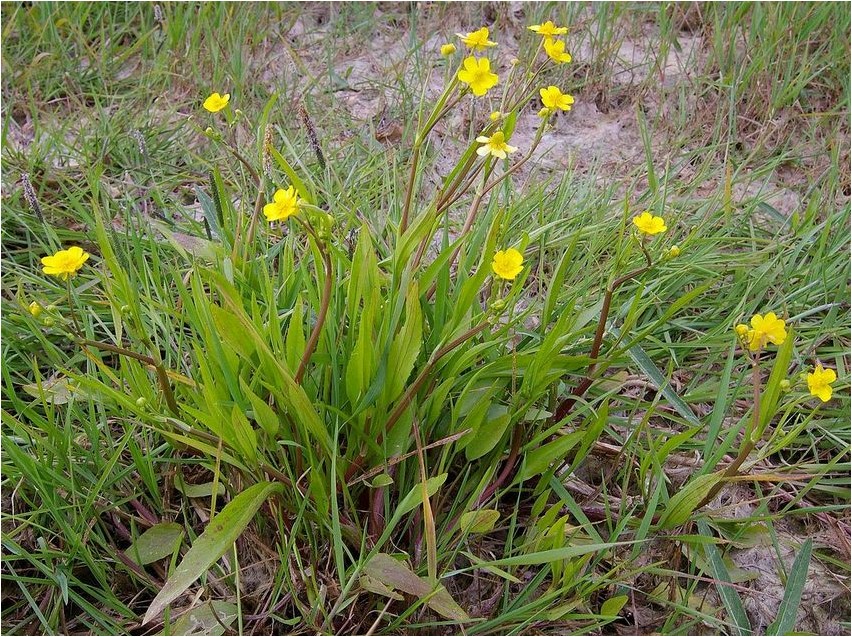
Buttercup is one of the plants of the family called Ranunculaceae; in Latin the name of this plant will be as follows: Ranunculus flammala L.
As for the name of the buttercup family itself, in Latin it will be: Ranunculaceae Juss.
Description of buttercup
Buttercup is a perennial herbaceous plant, the height of which will vary between fifteen and one hundred and twenty centimeters. The stems of this plant are single, they can be either ascending or erect, and will also be ascending, and can sometimes be rooted at the lower nodes, and at the top such stems will be branched. The basal leaves of this plant and the lower stem leaves are on equal petioles; sometimes they can be up to two times longer than the blade. The length of the buttercup plate is about three to seven centimeters, and the width will be three to twelve centimeters. Moreover, the upper stem leaves of this plant are narrow and almost linear; they can be either short-petioled or sessile. The peduncles of buttercup are finely grooved, the diameter of the flowers of this plant will be about ten to fifteen millimeters, they will be equipped with a corolla and five-leaf calyxes. The sepals of this plant will be hairy, their length is three to four millimeters, the petals are colored yellow, they will be broadly obovate and the length of such petals will not exceed five to six millimeters. The length of the fruits of the pungent buttercup does not even reach two millimeters; they are naked and endowed with a very short nose.
The flowering of buttercup occurs during the period from June to July. Under natural conditions, this plant is found in Belarus, Ukraine, Altai and the European part of Russia in all regions, with the exception of the Lower Volga region. For growth, this plant prefers river banks, floodplain damp meadows, sedge swamps, sometimes the plant can be found in water, but most often the burning buttercup grows in the forest zone.
Description of the medicinal properties of buttercup
Buttercup is endowed with very valuable healing properties, and it is recommended to use the herb of this plant for medicinal purposes. The presence of such valuable healing properties should be explained by the content of scopoletin and umbelliferone in the composition of this coumarin plant, as well as the following gamma-lactones: ranunculin and protoanemonin. It is noteworthy that buttercup herb is very often used as a homeopathic remedy.
For scurvy, it is recommended to drink juice made from the aerial part of this plant. It is recommended to drink this juice based on buttercup, diluted two to three drops in half a glass of water. As for traditional medicine, this plant is quite widespread here and is used to treat cancer.

It is recommended to use fresh mashed leaves of this plant topically: for this you will need to apply such leaves for scabies to sore spots, and these leaves of buttercup can also be applied to various tumors in order for them to be absorbed more quickly, or they are applied to abscesses, which will occur to accelerate ripening. It is noteworthy that if the herb of this plant is left on the body for a long time, it will cause quite severe skin irritation, and even ulceration.
It should be remembered that buttercup is a poisonous plant. For this reason, extreme caution is recommended when handling this plant. You should also remember that the internal use of this plant will require an even greater degree of caution.





