Calceolaria crenatiflora
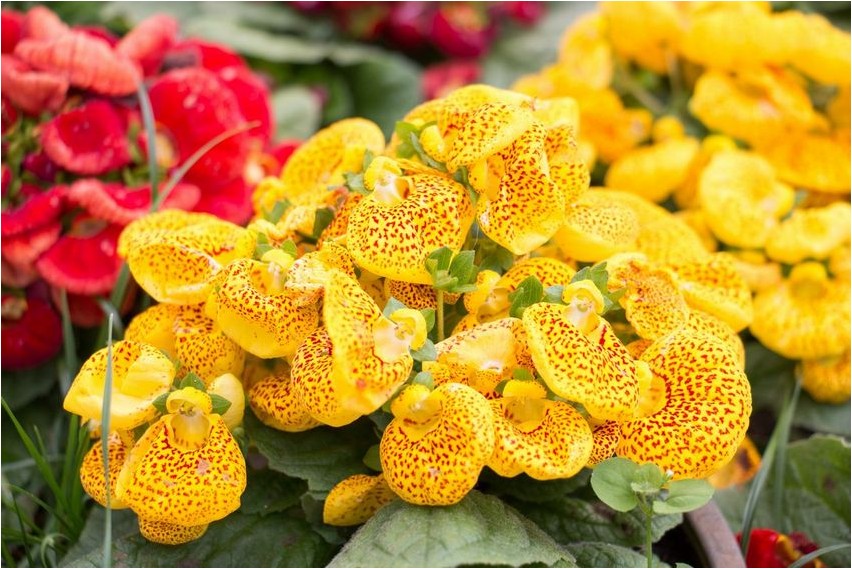
Calceolaria crenatiflora is also known as Calceolaria hybrida. The Latin name for this plant is Calceolaria crenatiflora.
Calceolaria crenatiflora belongs to the Scrophulariaceae family, which is also known as Scrophulariaceae.
Description of Calceolaria crenatiflora
For this plant to thrive, it requires not only full sun or partial shade, but also ample watering throughout the summer. Humidity should be maintained at a very high level. Calceolaria crenatiflora is a herbaceous plant. It can be found in winter gardens and numerous greenhouses. When grown indoors, it is used as an annual. It’s worth noting that Calceolaria serrata can reach a maximum height of up to thirty centimeters.
Care and Growing Instructions
It should be noted that Calceolaria serrata is most often grown as an annual. However, after flowering, it can be repotted into a standard pot and pruned. Regarding the soil composition, the following elements should be mixed in equal proportions: turf, compost, sand, and peat. The acidity of this soil should remain slightly acidic.
Among the specific requirements of this plant, it should be emphasized that Calceolaria serrata requires constant high humidity; however, stagnant water can have a very negative impact on its development. It’s also important to provide the plant with very cold conditions in winter, which can be quite difficult if the plant is growing indoors. When temperatures rise above 18 degrees Celsius and humidity is very low, Calceolaria serrataia will shed its buds.
Spraying is strictly contraindicated for this plant, as otherwise, both the leaves and flowers of Calceolaria serrataia can become covered in extremely unsightly spots. In some cases, the plant may be susceptible to attacks by whiteflies and aphids.

As for maintaining this plant during the dormant period, the temperature will need to be regularly maintained in the range between five and ten degrees Celsius. In this case, watering should be rare. The rest period begins in October and lasts until February: under indoor conditions, such a rest period is forced. And the reasons for the dormant period will be reduced illumination and insufficient air humidity.
Reproduction of Calceolaria crenate can occur both by sowing seeds and by cuttings. As for cuttings, this procedure should be performed while pruning this plant.
The surprisingly attractive flowers of Calceolaria crenate are endowed with decorative properties. The leaves of this plant are colored green, the basal leaves will be oval-ovate in shape, their lobes are quite well defined. The leaves are on very long petioles, while the stem leaves will be short-petioled, as well as opposite and sessile. This plant usually blooms in the summer; as for the color of the flowers, they can be white and yellow, red, and even orange.
Calceolaria – buns or shoes? Is a plant a bouquet or for life? Let’s get acquainted.