Meadow Pasque Flower
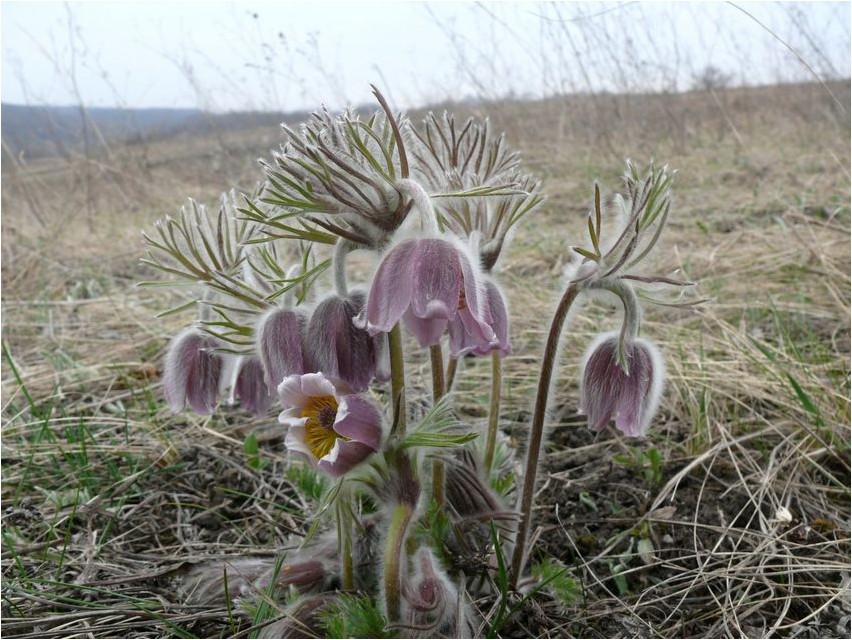
Meadow Pasque Flower is a member of the buttercup family. Its Latin name is Pulsatiella pratensis (L.) Mill. (Anemone pratensis L.).
The Latin name of the meadow pasque flower’s family is Ranunculaceae Juss.
Description of Meadow Pasque Flower
Meadow pasque flower is also known by the following common names: arrowroot, sleep-grass, postelen, forest pasqueflower, dream-grass, urchuy, samsonchik, suk, sheep’s grass, and razlapushnik. Meadow pasque flower is a perennial herbaceous plant with a fairly strong vertical rhizome and will continue to bloom until the leaves emerge. The basal leaves of meadow pasque flower are long-petioled, pubescent, and dissected into three bipartite segments. The lobes of this segment will bear two to four pointed, serrated lobes. Throughout the flowering period, the flower stalks of the meadow pasque flower will be covered with dense, soft hairs. The spathe of this plant is bell-shaped, consisting of leaves fused at the base. These leaves of the meadow pasque flower will be divided into linear, densely hairy lobes. The flowers of this plant are broadly bell-shaped, with only six tepals, ovate-pointed, and hairy on the outside. The flowers of the meadow pasque flower are blue-violet in color and are approximately three to four centimeters long. The stamens of this plant are shorter than the tepals and are yellow in color. The fruit of the meadow pasque flower have a densely hairy style, approximately three to five centimeters long.
This plant blooms from April to May. In the wild, this plant is found in Belarus, Ukraine, and most regions of European Russia. It prefers dry slopes, pine forests, open sandy hills, and forest edges.
Description of the medicinal properties of meadow pasqueflower
Meadow pasqueflower has very valuable medicinal properties, and its leaves are recommended for medicinal purposes. Harvesting this medicinal herb is recommended from April to May.
The presence of such valuable healing properties should be explained by the content of the steroid sitosterol, gamma-lactone ranunculin, chelidonic acid, triterpenoid beta-amyrin and gamma-pyrone derivatives in this plant. Saponins will be present in the roots of the meadow lumbago, traces of alkaloids were found in the stems, vitamin C and also traces of alkaloids are found in the leaves. The aerial part of this plant contains essential oil, anemonin, gamma-lactone and organic acids.

As for traditional medicine, here this plant is very widespread. Traditional medicine recommends using this plant as a sleeping pill and sedative. In addition, meadow lumbago is endowed with very effective fungicidal, expectorant, anti-inflammatory and bactericidal effects.
An infusion prepared from the herb of this plant is indicated for use in whooping cough, articular rheumatism, various female diseases and bronchitis. A decoction based on the aerial part of the meadow lumbago is used as an expectorant. It is noteworthy that the aqueous extract of the herb of this plant is indicated for use in fungal skin infections, as well as in dressing wounds.





