Plantain Cornut
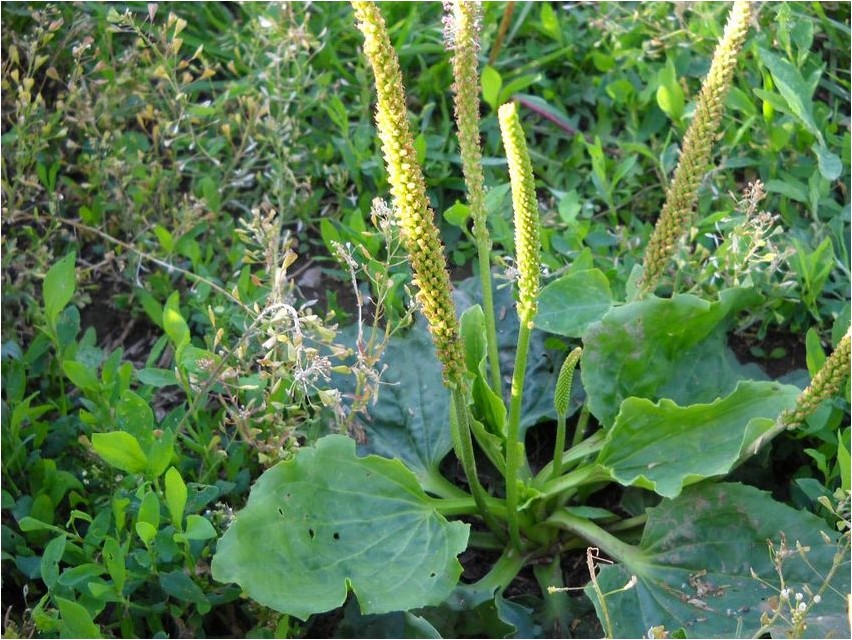
Plantain Cornuta is one of the plants of the family called plantains; in Latin the name of this plant will be as follows: Plantago cornuti Gorean (P. asiatica auct. non L.).
As for the name of the plantain cornut family itself, in Latin it will be: PIantaginaceae Juss.
Description of plantain cornut
Plantain cornuta is a perennial herbaceous plant whose height will vary between twenty and sixty centimeters. Such a plant will be endowed with approximately one to three flower shoots. The leaves of Plantain cornuta are ovate, thick, entire-marginal, wide and they are endowed with seven veins. The peduncles of this plant are more or less appressed, the length of the ears will be about five to twenty centimeters and they will not be thick. The corolla of the plantain cornuta is glabrous and will be endowed with short pointed and broadly ovate lobes, and the length of such a corolla will be about one and a half millimeters. The capsule of such a plant will be four-locular and ovoid-elliptical, and its length will not exceed four millimeters. Plantain cornuta seeds will be flattened and about two to three millimeters long.
Flowering of plantain cornut occurs in the period from June to August. Under natural conditions, this plant is found in Central Asia, the Caucasus, Eastern Siberia and the European part of Russia. For growth, this plant prefers salt marshes and saline meadows. As for its general distribution, plantain corn can be found in Mongolia, southern Central Europe, the Balkans, Asia Minor and the western Mediterranean.
Description of the medicinal properties of plantain cornut
Plantain corn is endowed with very valuable healing properties, and it is recommended to use the leaves and the entire above-ground part of this plant for medicinal purposes. The presence of such valuable healing properties should be explained by the content of essential oil, ursolic acid, flavonoids, steroids, polysaccharides and iridoids in the composition of this plant, while steroids and fatty oil will be present in the seeds.
In Tibetan medicine, cornut plantain has become quite widespread: the juice, decoction and infusion of the aerial part of this plant is used for pneumonia, pulmonary tuberculosis and various gastrointestinal diseases. It is noteworthy that the experiment proved that the leaves of this plant will exhibit antiulcer activity.

As an expectorant and bitterness, it is recommended to use the following very healing remedy based on this plant: to prepare such an effective remedy, you will need to take two tablespoons of crushed plantain leaves per one glass of boiling water. The resulting healing mixture should be infused for about forty to fifty minutes in a warm place, after which this mixture should be filtered very carefully. Take the resulting healing remedy based on plantain corn fifteen to twenty minutes before meals three to four times a day, one to two tablespoons. It should be noted that the same healing remedy based on this plant is also suitable for external use: this remedy is used in the form of a compress, rinsing and lotions as an antiseptic.
The juice of plantain leaves is used for chronic colitis, gastritis and peptic ulcers, which are not accompanied by high acidity. This remedy is used three times a day, a tablespoon diluted in half a glass of water.





