White Bryony
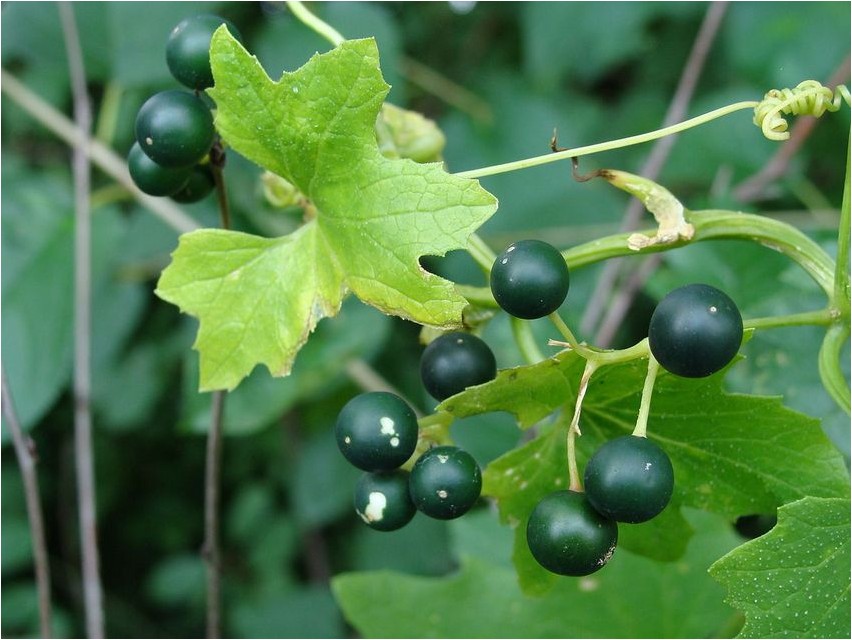
White Bryony is a member of the Cucurbitaceae family. Its Latin name is Brionia alba L.
The Latin name for the white bryony family is Cucurbitaceae Juss.
Description of White Bryony
White Bryony is known by many common names: black bryony, snake grass, black chokeberry, and taramishek-grass. White Bryony is a perennial herbaceous vine, reaching a length of about two to four meters. The stems of this plant are glabrous or may be studded with small spines. The leaves of white bryony are borne on fairly long petioles and are ovoid-triangular in shape, cordate and rough, with irregularly coarse teeth. The flowers of this plant are yellowish-white, with the staminate flowers arranged in racemes located at the very top of the stem. The pistillate flowers are borne in corymbose inflorescences. The corolla of the white bryony is five-lobed, yellowish in color, and features green veins. The fruit is a spherical berry colored in black tones.
The white bryony blooms from May to June. In the wild, this plant is found in Belarus, Ukraine, Moldova, Central Asia, the Caucasus, and all regions of European Russia, with the exception of the Trans-Volga, Karelo-Murmansk, Dvina-Pechora, and Lower Volga regions. In terms of general distribution, this plant can be found in northern Iran, Asia Minor, and Western Europe. White bryony grows in river valleys and gorges, forest edges, shrubby areas, cliffs, gardens, and parks. It’s worth noting that this plant is also ornamental and poisonous. All parts of the plant are poisonous, especially the roots, fruits, and young shoots.
Description of the medicinal properties of white bryony
White bryony has valuable medicinal properties, and it is recommended to use the roots, fruits, seeds, leaves, and stems of this plant for medicinal purposes. It is recommended to harvest the roots before flowering.
The presence of such valuable healing properties is recommended to be explained by the content of alkaloids, higher fatty acids, esters, brinolic acid, cucurbitacins, essential oil, sucrose, polysaccharides, starch, tannins, urea, methyl esters of oleic, palmitic and linoleic acid in this plant. Triterpenoids and tannins will be present in the aerial part of the white foot.

A decoction prepared from this plant is recommended for use in baths for rheumatism. It is noteworthy that preparations based on white foot are endowed with very effective antitumor properties, and the ethereal extract of this plant will exhibit rather low activity.
A tincture based on the fresh roots of this plant is used as part of a complex preparation for the treatment of plexitis, lumbago, rheumatism, radiculitis and neuritis.
It should be noted that the white step has become quite widespread in homeopathy. Here this healing remedy is used for neuritis, non-purulent buritis, bronchitis, headaches, various eye diseases, ascites, neuralgia, chronic arthritis, kidney prolapse, whooping cough, and also as a means of increasing the tone of striated muscles.





