Java apple
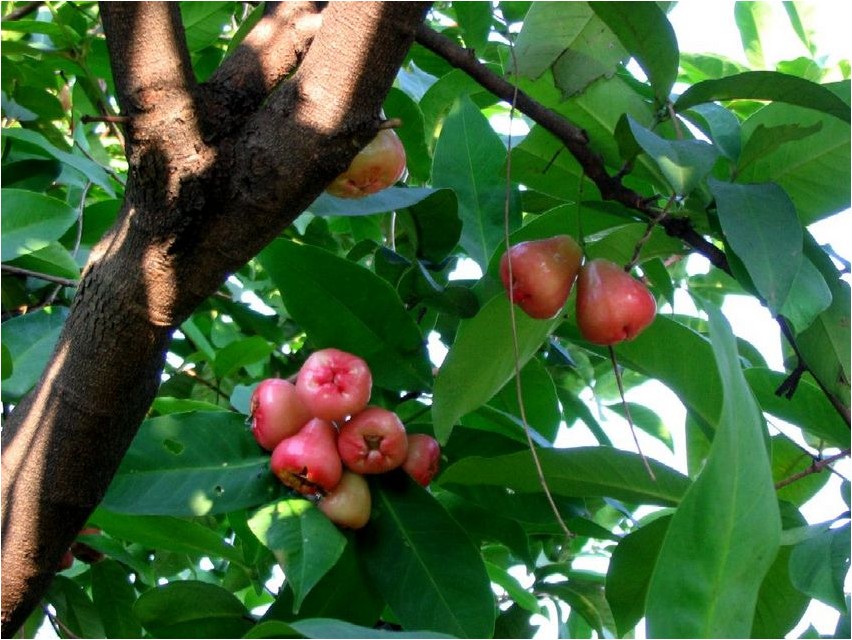
Java apple (lat. Syzygium samarangense) is a fruit crop that is closely related to the Malayan apple and belongs to the Myrtaceae family.
Description
The Java apple is an evergreen tree that can reach, depending on growing conditions, from five to fifteen meters in height. As for cultivated forms, they, as a rule, are always quite short in stature — this is necessary to make it easier to collect fruits.
The thickness of the short trunks ranges from twenty-five to thirty centimeters, and the top layer of pinkish-grayish bark easily crumbles at the slightest touch. The shape of the leaves is usually heart-shaped, elliptic-lanceolate, and their color boasts pleasant dark bluish-greenish hues. The leaves grow from five to twelve centimeters in width, and their length reaches from ten to twenty-five centimeters. By the way, the crushed leaves exude an amazing aroma!
The width of the yellowish-white flowers of the Java apple ranges from two to four centimeters. All of them are collected in colorful paniculate inflorescences and are equipped with many stamens and four graceful petals.
Glossy greenish or pinkish fruits are characterized by a pear-shaped shape. Their width is 4. 5 — 5. 4 cm, and their length is 3. 4 — 5 cm. The white, aromatic pulp crunches a little, and it tastes a little sour. Inside each fruit there are one or two miniature seeds.
Where does it grow
The Java apple originates from a relatively small range, as it is an endemic species, native to the Malacca Peninsula, as well as the Nicobar and lush Andaman Islands. Even in prehistoric times, it was introduced into the culture of a number of peoples of Southeast Asia. This crop has long been grown in Cambodia and Vietnam, as well as the Philippines, India, Taiwan, Thailand and Laos. And thanks to medieval sailors, the Javanese apple also found its way to some African states, in particular to Pemba and Zanzibar. Roughly at the beginning of the twentieth century, the inhabitants of Jamaica became acquainted with it, and somewhat later — the inhabitants of the Netherlands Antilles (such as Curacao, Bonaire and Aruba) and Suriname.

Application
The fruits of this crop are in most cases eaten fresh, but the scope of their food use is also quite wide. Slightly unripe fruits are even eaten with salt; in addition, excellent sauces are made from them, and they are also boiled like vegetables or stewed with various fruits and vegetables. And fully ripened fruits are used to make juices, jams, jams and preserves.
The flowers of this plant, rich in tannins, have found their use in folk medicine — for diarrhea, they will be an excellent fixative. And the excellent disinfecting properties of the fruits allow them to be used for a wide variety of gastrointestinal disorders.
The leaves of the Java apple have not been left without attention — they are the raw material for obtaining essential oil, which is widely used in the cosmetic industry. This oil is actively used to treat inflammation of the veins and rejuvenate facial skin. It also has an excellent tonic effect.
As for the bark decoction, it is drunk to get rid of fever — such a decoction is a powerful anti-inflammatory, diaphoretic and antipyretic agent.
Contraindications
There are currently no contraindications for consuming Java apple. However, the possibility of individual intolerance should not be ruled out.