Cattleya
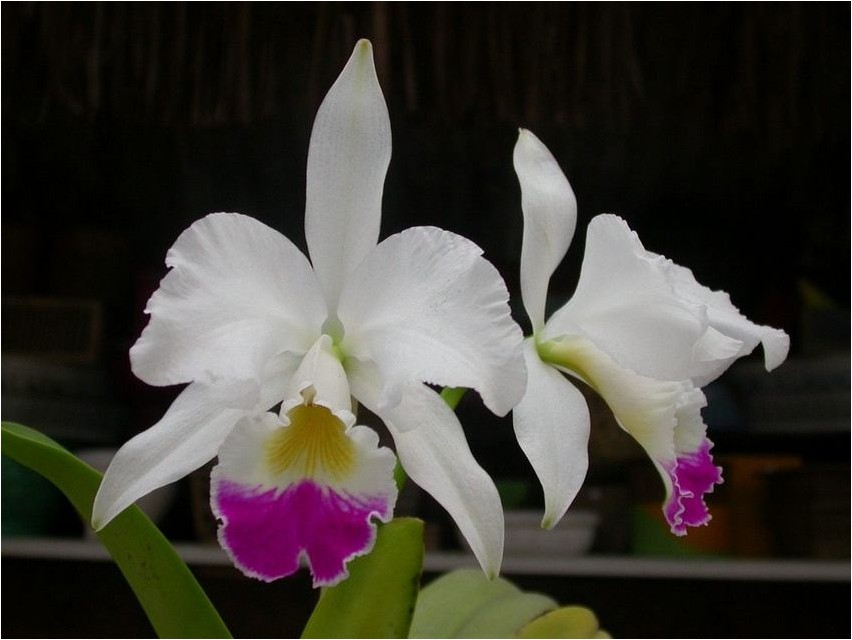
Cattleya (lat. Cattleya) is a fairly numerous genus of herbaceous perennial plants belonging to the Orchid family (lat. Orchidaceae). Native to Central and South America, members of the genus live in a wide range of environmental conditions.
A number of species are accustomed to the warm and humid climate of tropical forests with high rainfall. Some have to endure direct sunlight and proximity to ruffy cacti. And those who are destined to grow in the mountains are relatively cold-resistant and can withstand air temperatures dropping to minus two degrees Celsius. But, of course, even mountain orchids of the genus Cattleya cannot cope with long-term low negative temperatures, and therefore in Russia they grow in greenhouses and human homes, delighting with their bright large flowers in the autumn-winter period.
What’s in your name
The name of the genus “Cattleya” honors the memory not of botany, as is often the case with plant names, but of a person who was engaged in international trade, in particular, importing grain from Russia to England, and was also fond of collecting exotic plants, which was fashionable in the early 19th century in Europe. But it was precisely thanks to the experimental nature of William Cattley (1788 – 1835), who especially loved orchids, that they gained enormous popularity among Europeans.
Cattleya entrusted the description of orchids to the professional botanist John Lindley (John Lindley, 1799 – 1865), a great expert on plants of the Orchidaceae family, who, for a fee, compiled a Catalog of the Cattleya plant collection. At the suggestion of John Lindy, the plant genus was given the name of the collector.
Interestingly, on the plaque at William Cattley’s house in Barnet it is written: “William Cattley, Botanist….”
The type plant species of the genus is “Cattleya labiata”, with flowers having tubular lush petals, one of which is much larger than the others and more brightly colored. In addition, the shape of this petal resembles a lip.

Since orchids of this genus were studied and described by different botanists at different times, the official Latin name “Cattleya” has many synonyms, making it difficult for both botanists and fans of the brightly flowering plant kingdom.
Description
Plants of the genus Cattleya can be epiphytes, living on tropical trees, or lithophytes, spreading their strong rope-like roots on rocky mountain slopes.
Among the species of the genus there are plants with large and bright flowers, as a rule, emitting a pleasant aroma, with a pronounced shape characteristic of all Orchids, and there are representatives with small flowers that grow in the harsh conditions of mountainous areas. The flowers are very picturesque and unique, with a wide variety of colors.
The nutrient stores of orchids of the genus Cattleya, pseudobulbs and bulbs can be of different shapes:
* spindle-shaped fleshy elongated pseudobulbs, sometimes flattened, showing one apical leaf to the world;
* cylindrical long bulbs, revealing to the world, as a rule, two apical leaves, rarely more than two.
Plant leaves can be fleshy and juicy, or tough and leathery.
Varieties
Precisely determining the number of species in a genus is a futile exercise. Different sources give numbers from 65 to 187 species. Let’s mention a few of them:
* “Cattleya labiata” (Cattleya labiata) is the type species of the genus.
* “Cattleya maxima” (Cattleya the largest) – with large beautiful flowers.
* “Cattleya luteola” (Cattleya luteola, or yellow) – with flowers ranging from lemon to yellow-greenish in color.
* “Cattleya violacea” (Violet Cattleya) – with noble purple petals.
* “Cattleya lawrenceana” (Lawrence’s Cattleya) – with one apical leaf. Difficult to grow in culture.
* “Cattleya trianae” (Cattleya Triana) – has a spindle-shaped single-leaved pseudobulb and very beautiful multi-colored petals with a wavy-toothed edge.
* “Cattleya warneri” (Cattleya Warner) – the flowers are a little similar to the flowers of the previous species.