Gypekoum direct
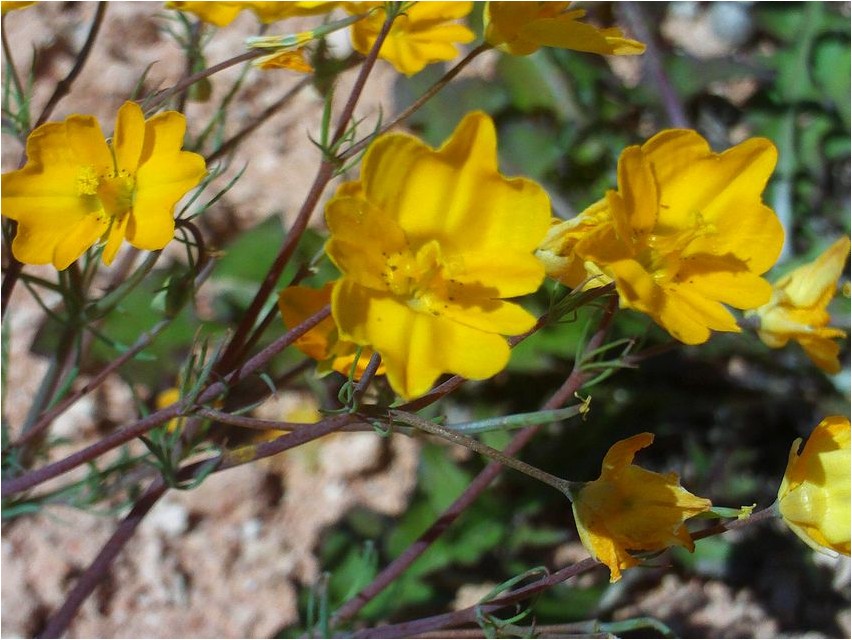
Hypecoum erectum is one of the plants of the family called poppy; in Latin the name of this plant will be as follows: Nuresoum erectum (L.).
As for the name of the Hypecouma direct family itself, in Latin it will be like this: Papaveraceae Juss.
Description of direct hypocomum
Hypekoum straight is a perennial herbaceous plant, the height of which will be about ten to thirty-five centimeters. The leaves of this plant are bluish, they are cut into thread-like segments. The stems from the middle of the straight hypocoum will transform into a dichosial multi-flowered inflorescence, the stalks are straight and quite strong, and their length will be about three centimeters.
The sepals of this plant are ovate-triangular, they are sharp, and along the edge they will be narrowly membranous, their length will be about two to three millimeters. The corollas are painted in yellow or pinkish-white tones, these corollas are large, and the outer petals will be broadly fan-shaped and three-lobed, their width will be approximately fifteen centimeters, while the length will be the same. The fruits of this plant are pods that are narrow-linear and straight, their length is approximately seven to eight centimeters, and their thickness is one and a half millimeters. The seeds of this plant are oblate-octahedral, dark brown in color, and their length is only slightly more than a millimeter.
This plant blooms from May to August. Under natural conditions, this plant is found in the Altai region of Western Siberia, as well as in the Angaro-Sayan and Daursky regions of Eastern Siberia. As for the general distribution, this plant can be seen in Japan, Mongolia, North-East and North-West China, as well as on the Korean Peninsula. For growth, Hypecomum straight prefers dry sand and dry steppes, as well as rocks and pebbles.
Description of the medicinal properties of straight hypocomum
Hypecomum straight is endowed with very valuable healing properties, and it is recommended to use the herb of this plant for medicinal purposes. The concept of grass of this plant includes stems, flowers and leaves.

The following alkaloids were found in the aerial part of Hypecoum rectum: hypocorinine, carotenoid, protopine, beta-allocryptonine, kryptonine, fumaritin, stolopins, synactin and sanguinarine. The stems of this plant also contain alkaloids, hypocorine, hypocorinine and protopine. Protopine is also found in leaves, buds, flowers and fruit valves, and the fruits of this plant contain alkaloids. Preparations based on this plant have antipyretic, virostatic, antibacterial, analgesic, anti-inflammatory and pronounced hypotensive effects. It is noteworthy that the sum of direct hypocoum alkaloids can have a fairly distinct antiarrhythmic effect.
In folk medicine, an infusion prepared from the herb of this plant is used for infectious diseases as an analgesic and antipyretic. This plant is also used for cancer and diseases of the teeth and pharynx mucosa. It is worth noting that in China, a decoction of the herb Hypecoma directa has become quite widespread for laryngitis and red eyes.
For various oncological diseases, it is recommended to use the following remedy: to prepare it, take five grams of dry crushed herb of this plant per glass of boiling water. This mixture should be infused for two hours, and then it is carefully filtered. Take this remedy half a glass three times a day for about two to three months.