Chinese dodder
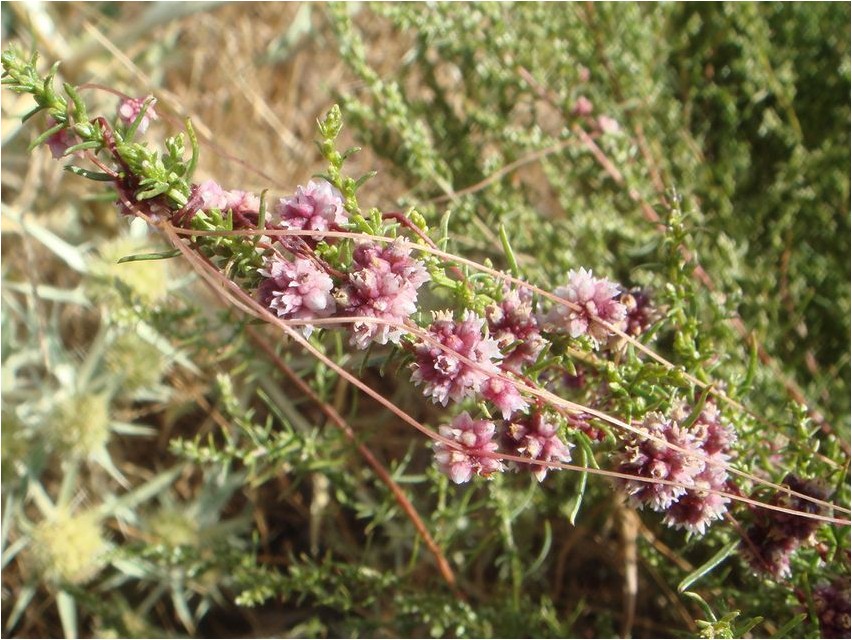
Chinese dodder is one of the plants of the family called dodder; in Latin the name of this plant will be as follows: Cuscuta chinensis Lam.
As for the name of the Chinese dodder family itself, in Latin it will be: Cuscutaceae Dumort.
Description of Chinese dodder
Chinese dodder is an annual herbaceous plant with rather thin and thread-like stems. The diameter of the stems of this plant will not reach even one millimeter; such stems will be smooth and bare, and they are painted in light yellow tones. The length of the Chinese dodder flowers will be about four millimeters, they are on rather short stalks and are colored yellowish. Such flowers can be either slightly shorter than the calyx, or equal in length; these flowers, three to seven pieces, are located in a small umbrella-shaped inflorescence. At the base, such flowers will be endowed with almost transparent keeled, entire and narrow triangular bracts.
The calyx of this plant will be broadly conical, its length is two to two and a half millimeters. Such a calyx of Chinese dodder is cut in half into obtuse, sharp-keeled and triangular-ovate lobes, while the calyx itself seems somewhat knotty.
Chinese dodder blooms from May to June, while the ripening of the fruits of this plant lasts from June to September. Under natural conditions, this plant is found in Central Asia, as well as in the Primorsky region and in the west of the Amur region of the Far East. As for the general distribution, this plant can be found in Japan, Iran, China, Mongolia and Afghanistan. For the growth of Chinese dodder, it prefers weedy places, weeds and crops. In addition, such a plant can infect other crops.
Description of the medicinal properties of Chinese dodder
Chinese dodder is endowed with very valuable healing properties, and it is recommended to use the grass and seeds of this plant for medicinal purposes. The concept of grass includes the leaves, flowers and stems of this plant.

The presence of such valuable medicinal properties is believed to be explained by the presence of sugars, resins, cholesterol, stigmasterol, beta-amyrin, wax, and fats in the seeds of this plant. The herb, in turn, contains amarbelin, cuscutin, kaempferol, bergenin, and cuscutalin, which is a pharmacologically active substance.
In folk medicine, this plant is quite widespread. The herb is recommended as a valuable choleretic, while the seeds are used as a laxative, diaphoretic, anthelmintic, and carminative.
Chinese dodder is used for urinary incontinence, scabies, leucorrhoea, for washing wounds, and as a topical treatment for blenorrhea. Chinese dodder seeds are used for hypertension, pneumonia, impotence, and nephritis, and are also used as a tonic, expectorant, tonic, and choleretic. A poultice made from a decoction of young shoots is indicated for eye inflammation, sores, and ulcers.
Furthermore, this plant is used as a muscle and bone strengthener, and is also used for dizziness, enuresis, severe fetal restlessness, general weakness, rabies, nocturnal emissions, sore throat, and fevers. It should be noted that this plant is very valuable, and positive results from its use will be noticeable quite quickly.





