Chrysophyllum
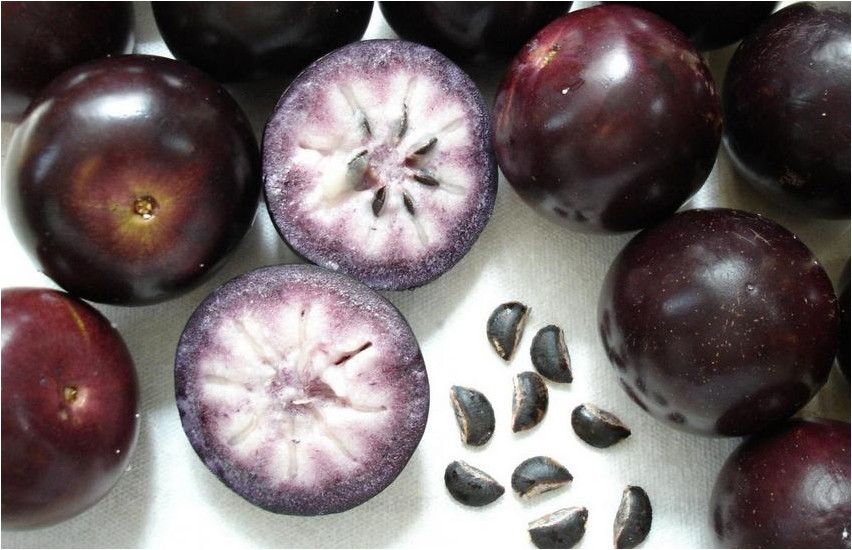
Chrysophyllum (lat. Chrysophyllum cainito) is a luxurious evergreen tree belonging to the well-known Sapotaceae family. The fruits of this tree are often called star apples.
Description
Chrysophyllum is a fast-growing tree whose height can vary from eight to ten meters. Each tree is endowed with a very dense crown and a rather short trunk.
The oval shiny leaves of chrysophyllum grow from five to fifteen centimeters in length. They are usually dark green on top and velvety and golden brown underneath.
Fragrant miniature chrysophyllum flowers are painted in purple-whitish tones and are formed exclusively in the leaf axils.
The rounded fruits of the handsome chrysophyllum tend to set without pollination and reach a diameter of five to ten centimeters. Currently, there are two forms of fruit: with white flesh and delicate greenish skin, or with bright purple flesh and colorful dark purple skin.
The skin of the formed fruits is always shiny, smooth and thin, and their pulp is reliably protected by an inner crust reaching a thickness of 5 — 10 mm. True, this crust thickness is relevant only for purple fruits, and for greenish specimens the thickness of the crusts usually does not exceed 3 — 5 mm.

The very sweet and rather soft pulp of the fruit is surrounded by gelatinous cells in the amount of six to eleven pieces. In cross-section, they resemble the rays of a star diverging from the middle — this is what determines the second name of the fruit. In addition, up to ten seeds can be found inside each fruit, the average length of which is two centimeters. And higher quality fruits usually have fewer seeds. Fresh seeds may appear black at first, but as they dry they turn a light brownish color.
Chrysophyllum fruits usually ripen from early spring to summer, but in some tropical areas they ripen throughout the year. And since ripe fruits do not tend to fall off, they are carefully cut off along with small sections of twigs.
Only fully ripe fruits should be collected, as unripe specimens are usually inedible and very astringent. It is quite easy to identify ripe fruits — they become wrinkled, and when you press on them, you feel their softness and pliability. By the way, ripe fruits can be stored in the refrigerator for three weeks.
How to eat chrysophyllum
The peel of the fruit and its peel, which takes up approximately 1/3 of the total volume of each fruit, are inedible in chrysophyllum. When peeling these unusual fruits, it is important to ensure that the bitter latex contained in their crusts does not get into the flesh.
Immediately before consumption, ripe fruits are cooled and cut into two parts. The juicy pulp can be eaten with a spoon, avoiding the seeds and surrounding seed cells. Citrus juice can significantly improve the taste of the pulp.
In Jamaica, the pulp is crushed and combined with citrus fruits, mango, pineapple and some other fruits, as well as coconut milk. This mixture is then frozen and eaten as a dessert. You can also combine the pulp of the fruit with orange juice, a spoonful of sherry, grated nutmeg and a small spoonful of sugar — the taste of this delicacy is somewhat reminiscent of the taste of the strawberries and cream dessert.
The slightly bitter emulsion from chrysophyllum seed kernels is widely used to make nougat and many other sweets.
Growing
Chrysophyllum grows well in containers with a thick layer of drainage and a fairly loose soil mixture. At the same time, it feels equally good both in light partial shade and in sunny places. Chrysophyllum also loves periodic spraying and humidified air.
The beautiful chrysophyllum can be propagated both by seeds and by air layering or grafting. But this crop begins to bear fruit only after five to ten years.