Koleria hairiflora
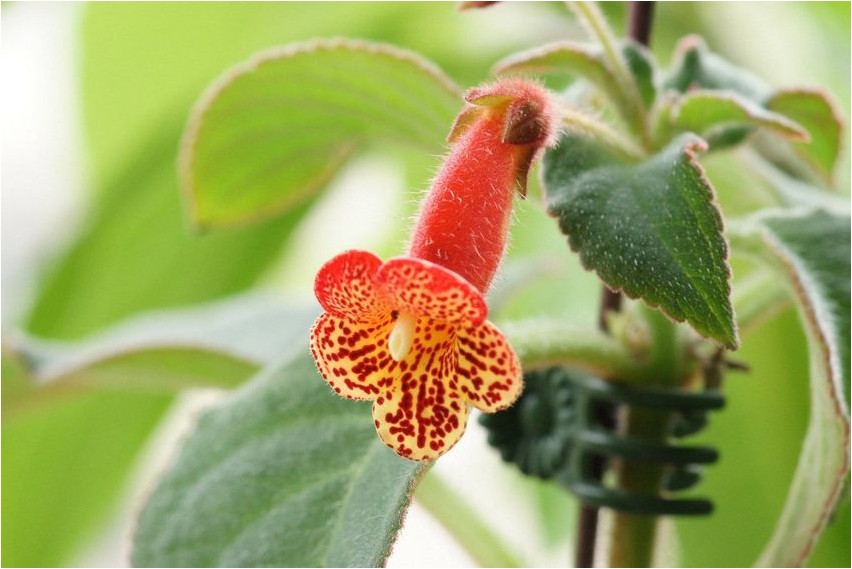
Kohleria pilosa is also known as Kohleria eriantha. In Latin, the name of this plant will be as follows: Kohleria eriantha.
Koleria hairiflora is one of the plants of the family called Gesneriaceae; in Latin the name of this plant will be: Gesneriaceae.
Description of the hairy-flowered variety
For the favorable cultivation of this plant, it will be necessary to provide the plant with a sunny light regime or a partial shade regime. At the same time, throughout the entire summer period, watering should remain moderate, while air humidity is recommended to be maintained at a fairly high level. The life form of Koleria pilosiflora is a rhizomatous plant.
This plant can most often be found indoors, where preference should be given to the brightest windows. At the same time, sometimes Coleria pilosa is also grown in winter gardens. As for the maximum size in culture, the height of the hairy-flowered variety is about fifty centimeters.
Description of the features of care and cultivation of Coleria pilosiflora
For the favorable development of this plant, one should not forget about timely replanting. Replanting should be done every year in the spring, and replanting the plant is permissible only after the end of the dormant period. To replant, you need to mix one part each of sand and peat, as well as two parts of leaf soil. The acidity of such soil can be either slightly acidic or acidic.
It should be noted that Koleria pilosa does not tolerate stagnation of water in the soil, and sometimes the plant can be susceptible to damage by whiteflies, spider mites and scale insects.

Throughout the rest period, it is necessary to maintain an optimal temperature regime between fifteen and eighteen degrees Celsius. As for watering, at this time watering should be rare, and air humidity can remain standard. It should be noted that the dormant period is forced when the plant grows indoors. The dormant period begins in October and continues until February. The reasons for this period are not only low air humidity, but also insufficient lighting.
Reproduction of Coleria pilosiflora can occur by dividing the rhizome, which should be done during transplantation. In addition, propagation is also possible by rooting apical cuttings. It should be noted that this plant should not be sprayed under any circumstances, otherwise the leaves of Koleria pilosiflora will immediately become covered with spots.
Both the leaves and flowers of this plant have decorative properties. The leaves of Koleria pilosa are green in color and oval in shape. In addition, such leaves will also be pubescent along the edges; the bottom of these leaves will be endowed with burgundy hairs. The length of these leaves of Koleria pilosiflora is approximately fifteen centimeters, and their width reaches eight centimeters. It should be noted that this plant blooms literally all year round.
As for the color of the flowers of this plant, they can be yellow, red, or even orange. The flowers of Koleria pilosa are bell-shaped, they are endowed with yellow dots, and most often they are red-orange in color. The length of such flowers will be about five centimeters, and the flowers themselves will be single. As for the stem, it can be not only lodging, but also erect.