Clematis
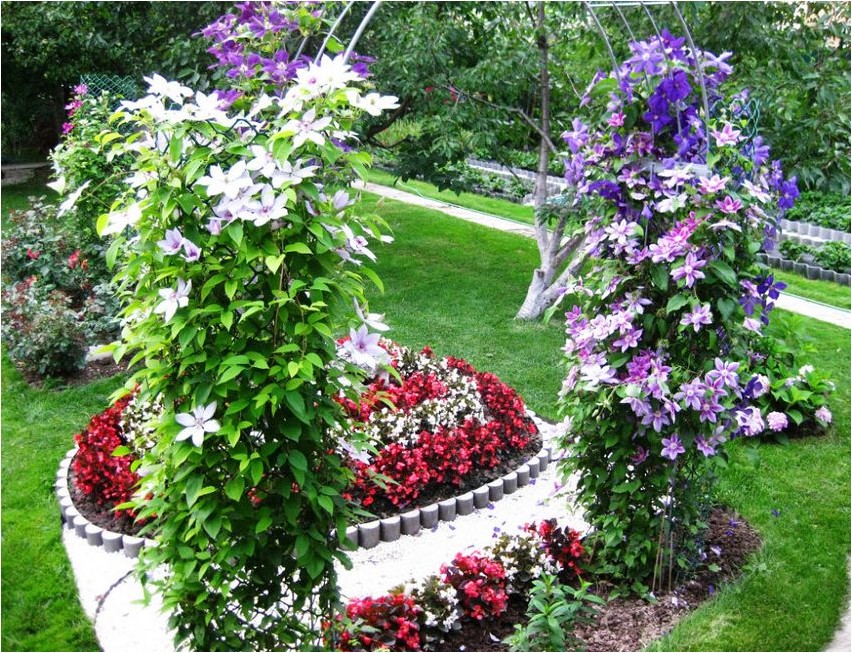
Clematis (lat. Clematis) is a liana-shaped shrub, a herbaceous perennial plant of the Ranunculaceae family. In Russia, this crop is often called Clematis.
Characteristics of culture
Clematis is a perennial herbaceous or woody plant, the stems of which are often climbing and climbing, less often straight. The leaves are dense, from simple oval with an entire edge to complex imparipinnate with a serrated edge, opposite.
Inflorescence — there are inflorescences, but more often large, up to 18 cm in diameter, single flowers, simple or double, with a large number of stamens. Terry species are characterized by the presence of an underdeveloped sterile stamen, devoid of an anther. Corolla of perianth of 4, less often 5-8 petals. The fruit is a multi-nut.
Popular varieties
* Beszczady (Bieszczady) is a vine with shoots up to 2-3 m long. Large flowers up to 20 cm in diameter are composed of 6-8 pink petals with a white stripe in the middle of the petal. In the center of the flower there are pink stamens with burgundy anthers. The leaves are oval with a smooth edge. Blooms from June to September, prefers partial shade. Looks good on chain-link mesh, lattice supports, and on coniferous or deciduous shrubs.

* Ville de Lyon — a shrubby vine quickly reaches a height of 3. 5 m. Crimson, carmine-red flowers up to 15 cm in diameter fade in the sun. The anthers of the stamens are bright yellow. Blooms profusely from mid-June to late September. The shape of the leaves is often complex. Easy to care for, cold-resistant.
* General Sikorski — profusely flowering vines 2-3 meters high. The flowers are large, violet-blue with wavy edges, with a large number of yellow stamens in the center. They bloom on the shoots of the current and last year from July until frost. They leave behind fluffy decorative fruits. Thick stems, large leaves and flowers require strong support.
* Comtesse de Bouchaud is a relatively low vine, reaching a height of 2 m, suitable for a small summer cottage. Pink with a slight shade of purple, large flowers are composed of 6 petals with light yellow stamens in the center. It blooms profusely and for a long time on the shoots of the current year. Undemanding, indifferent to cold and disease, ideal for beginning gardeners.
* Romance (Romantika) is a vine that grows up to 2. 5 m in height. Blooms profusely on the shoots of the current year from July to late autumn. Dark purple, velvety flowers reach a diameter of 10-12 cm. To maintain a dark shade, it is advisable to shade the plant. Looks good against the background of shrubs with yellow foliage or flowers.
Growing conditions
Clematis is a sun-loving crop that prefers loose, manured soils and abundant watering during the dry summer period. In areas with hot climates, it is better to shade the plant. On poor soils, the shrubs are stunted and the flowers are smaller. Does not like wind and drafts. There are varieties that are less demanding to care for and are frost-resistant. Requires periodic pruning of shoots, partially or to ground level.
Landing
Clematis is planted in spring or autumn. The depth of the planting pit should be 50-60 cm. The soil removed from the pit is thoroughly cleaned of weed roots and mixed with humus, sand, and peat in equal quantities. Add superphosphate, mineral fertilizers, chalk or lime, and wood ash. Mix and fill the hole to the middle.
The soil is compacted and a mound is built. Straighten the roots and place them on a mound. Gradually add the rest of the mixture. Vegetative buds should be below the surface of the ground to form a tillering center and protect from heat and cold. The second time the soil is compacted, watered abundantly, and the surface is mulched.
Care
Caring for clematis includes several tasks:
* Selection of strong, reliable support.
* Protection from insect pests (mole crickets) and small rodents (field mice, rats, moles).
* Abundant watering during the hot period of the season.
* Periodic fertilizing with fertilizers and mulching the soil.
* Pruning shoots is an important stage of care. The timing, height of pruning, and the number of shoots trimmed or cut out depend on the variety, the presence of diseases, and the decorative function of clematis.
Clematis for beginners
https://www. youtube. com/watch? v=eo_mYQmyJK4
Clematis
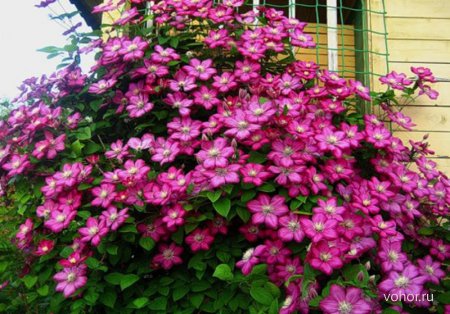
Widespread plants on our planet include clematis, plants of the ranunculaceae family. They are not found only on the Antarctic continent. They have been known in Russia since the 19th century, when they first appeared in greenhouses. Clematis (another name for clematis) became widespread among gardeners in the second half of the 20th century. The species diversity of clematis is very large, which allows you to choose the required variety for specific climatic conditions. There are varieties known that can cope even with short-term frosts down t o-5 degrees and continue flowering after warming.

where to plant?
Clematis belongs to the group of light-loving plants. When planting in the middle zone in shady places, you may not achieve flowering. Clematis propagation by cuttings is most suitable. And only in the southern regions can we recommend for disembarkation these beautiful flowers are places that will be shaded at noon. This is necessary in order to avoid overheating of the soil, to which clematis is quite sensitive. Although these flowers are demanding of soil moisture and love abundant watering, it will be impossible to achieve good growth in places with waterlogged soil. Therefore, it is necessary to think in advance about measures for draining the soil in the place where you plan to plant flowers. The soil should have a neutral reaction, but can be either slightly acidic or slightly alkaline.

planting clematis.
Clematis propagation by cuttings. Plants are carefully prepared for planting seat clematis can grow for more than 20 years, so preparation must be very serious. The size of the landing pit should not be less than half a meter deep. The length and width of the hole are equal to its depth. Make up a soil mixture of approximately the following composition: humus (compost) — 2 buckets, peat and sand — 1 bucket each, 200g of mineral fertilizer (complete), superphosphate — 100g, chalk (lime) — 200g, bone meal — 100g. At the bottom of the pit, drainage is arranged from large crushed stone and broken bricks.
When to replant clematis? Planting in the southern regions and middle zone is carried out in the autumn, in the northern regions — in the spring. Seedlings are planted with a depth of 10-18 cm, depending on the age of the seedling. The older the seedling, the deeper it is buried.

care.
the most important thing that growing clematis needs is strong and reliable support. Most often this is a frame assembled from pipes or fittings. Wire strings are not suitable, since a developed clematis bush has a large windage, and the wire will not withstand gusts of wind.
Watering the bushes should be done quite rarely, but at the same time very abundantly. During the season, it is necessary to carry out 3-4 fertilizing with complex fertilizer. During the flowering period, it will be useful to water (one-time) using boric acid and potassium permanganate (2 grams per 10 liters of water).
The plant is pruned to form a beautiful bush. But it is important to carry out autumn pruning correctly. For the winter, cut off all dry, broken and weak branches. The most powerful and strong ones are shortened to a length of 1-1. 5 m.
By following these simple rules, you can achieve excellent results, and clematis will delight the owner with colorful flowering.





