Forsythia
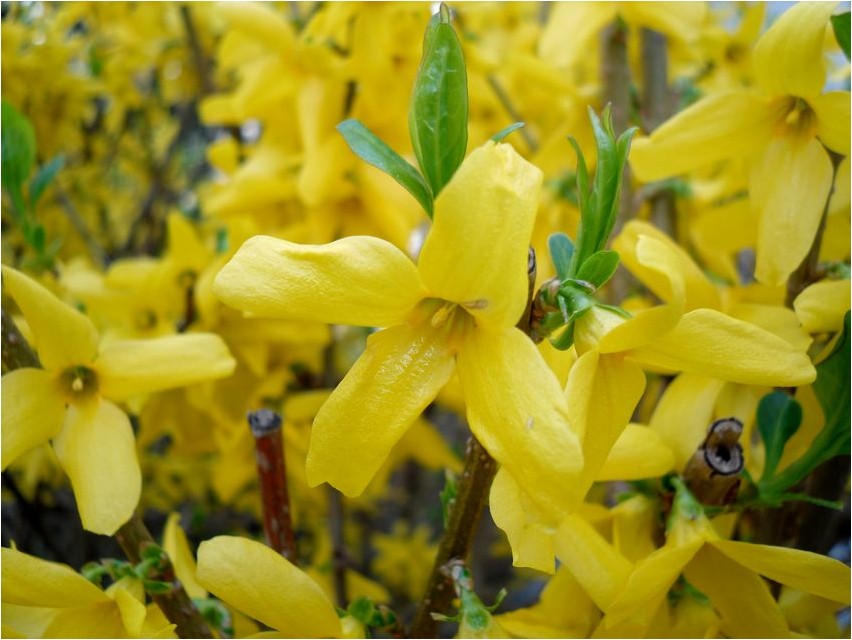
Forsythia (lat. Forsythia) or forsythia is a genus of beautifully flowering ornamental shrubs of the Olive family. Forsythia is found in the wild in Southeast Europe and East Asia.
Characteristics of culture
Forsythia is an early flowering deciduous shrub with a height of 1 to 3 m, less often up to 6 m. The bark is quite rough, gray-brown in color. The leaves are bright green, opposite, simple, sometimes trifoliate, have no stipules, oval or oblong, serrated edges, pointed tips. The leaves appear later than the flowers and retain their fresh color for a long time.
The flowers are bright yellow or bright orange, bell-shaped, solitary or collected in small inflorescences of 2-6 pieces, 2. 5-3 cm in diameter. The calyx is four-lobed. The corolla is fused-petaled and consists of four lobes. Flowering occurs in April — May, lasting on average 20-25 days. The fruit is a two-locular capsule with numerous winged seeds.
Growing conditions
Forsythia is a light-loving crop that grows well in sunny areas protected from strong winds. Easily tolerates partial shade. Forsythia prefers well-drained, moderately moist, fertile soils with a neutral pH. The optimal growing temperature is 20-25C.

Reproduction and planting
Forsythia is propagated by seeds, cuttings or layering. Sowing the seed is carried out in early spring or autumn under cover in the form of peat or sawdust. Seeds need preliminary stratification. Seedlings are planted in a permanent location after 3-4 years. Reproduction by layering is the most effective and common method. To do this, the falling branches of forsythia are bent to the surface of the earth, secured on both sides, the bark is cut at the point of contact of the shoot with the soil and sprinkled with a layer of 10-15 cm. In the spring, the rooted cuttings are separated from the mother plant and transplanted to a permanent place.
The crop is also propagated by green and lignified cuttings. The cuttings are cut in early June, they are kept in a solution of the growth stimulator “Kornevin”, then planted in the soil and covered with film. By autumn the cuttings take root. In winter, the soil of young plants is mulched with peat or dry leaves.
Forsythia seedlings are planted in the fall. Planting holes are prepared in advance; they should be approximately 70-80 cm deep and 60-70 cm wide. The distance between plants should be at least 1-3 m, depending on the variety. Fill the planting holes 1/4 full with a drainage layer (broken brick or crushed stone), add a soil mixture (humus, garden soil, and sand in a 1:1:2 ratio), then lower the seedling into the soil, spreading the roots, and cover with the remaining mixture. After planting, water the plants thoroughly and mulch with peat.
Care
Forsythia requires a fair amount of mineral and organic fertilizer. The first feeding is done in early spring, the second after flowering, and the third in late fall. The plant requires sanitary and formative pruning, weeding, and loosening. Watering is recommended during dry weather. For winter, cover the plants with spruce branches or other material, and mulch the area around the trunks. Forsythia is resistant to diseases and pests, rarely being affected by bacterial wilt or nematodes. In the former case, the shrubs should be destroyed; in the latter, the soil should be disinfected with carbation.
Applications
Forsythia is a highly ornamental plant that fits perfectly into gardens of any style. Forsythia looks spectacular planted individually or in groups, and is ideal for creating hedges. It combines well with other deciduous and coniferous shrubs and trees. Weeping forsythia is used in folk medicine. Some species are used to make bows for string instruments. Flowering Shrubs That Don”t Bring You Joy. Part 1. Forsythia