Gmelin’s Mordovnik
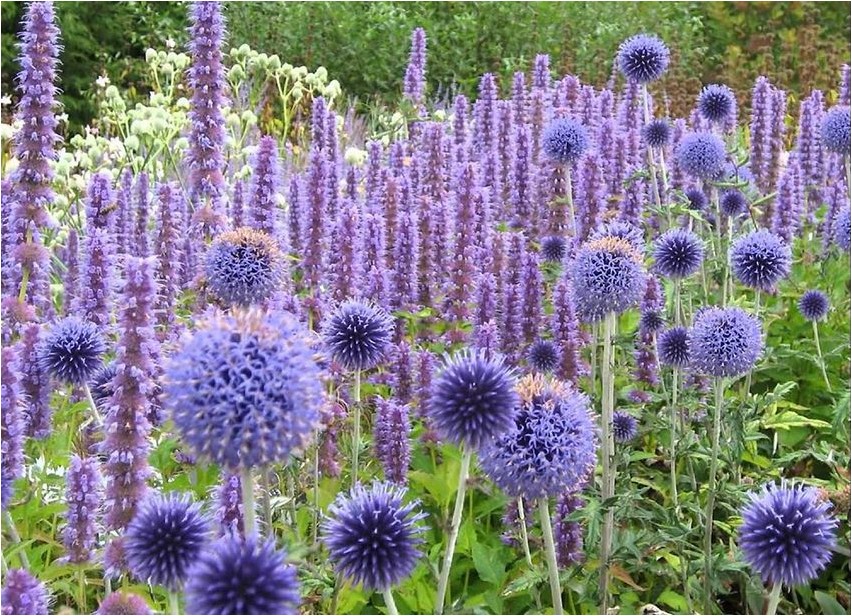
Echinops Gmelin is one of the plants of the family called Asteraceae or Asteraceae; in Latin the name of this plant will be as follows: Echinops Gmelinii.
As for the name of the gmelina family itself, in Latin it will be like this: Asteraceae Dumort. (Compositae Giseke).
Description of Echinops gmelina
Mordovnik gmelina is an annual herbaceous plant, the height of which will fluctuate between fifteen and thirty centimeters. The stem of this plant can be either simple or splayed-branched at the very base. Such a stem will be endowed with quite numerous glandular-hairy stalked glands, the length of which will be equal to two to five centimeters and the width will be half a centimeter. Along the edges of such a stem will be equipped with bare needle-like spines. The leaves of Echinops gmelina are mainly lower leaves, while on top they will be barely felted with long and tangled hairs. The middle and upper leaves of this plant are endowed with glandular hairs on both sides, and on top they will be colored green. The heads of Echinops gmelin are painted in whitish tones, they are spherical, they can reach up to three centimeters in diameter, and such heads will be located one at a time at the very ends of the branches. In this case, the outer bristles of this plant will be almost equal in length to the involucre, the leaves of the involucre are imbricated and oblong-linear, while the outer ones will be pointed at the spine, and the inner leaves are fringed at the top. The fruit of Echinops gmelina is a densely hairy achene.
This plant blooms in June, while fruiting occurs in August. Under natural conditions, Echinops gmelina is found in the Altai region of Western Siberia. As for its general distribution, this plant can be found in China and Mongolia. For growth, the plant prefers sandy deserts and sandy-rocky soil.
Description of the medicinal properties of Echinops gmelina
Echinops gmelina is endowed with very valuable healing properties, and it is recommended to use the inflorescences and roots of this plant for medicinal purposes.
The presence of such valuable healing properties should be explained by the content of alkaloids in the stems and leaves of this plant, while the flowers contain the flavonoid apiin.

As for traditional medicine, here this plant is quite widespread. A decoction prepared from the roots of Echinococcus gmelina is recommended for use against ulcers, stomach cancer, bone gum, liver echinococcus, and also as an antiemetic. It is noteworthy that this plant is used in various medicinal preparations for diseases of the nose and throat. An infusion and decoction prepared from the inflorescence of Echinops gmelina is indicated for oral use for headaches, pneumonia, gastroenteritis and neurosis.
For chronic tonsillitis, it is recommended to use the following remedy based on this plant: to prepare such a healing remedy, you will need to take eight grams of crushed roots of Echinops gmelina per three hundred milliliters of water. The resulting healing mixture should be boiled over fairly low heat for about five to six minutes, then the mixture should be left to steep for about two hours, after which the mixture should be filtered very carefully. Take the resulting medicinal product based on Echinacea gmelin three times, essentially one third of a glass. It is important to note that if properly prepared and taken, this remedy will be very effective.





