Roofing skid
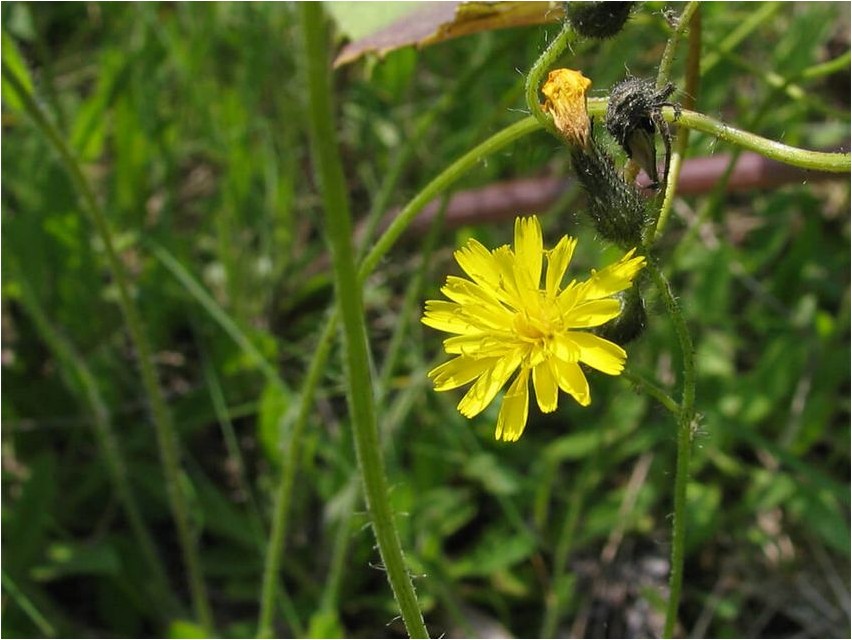
Roofing skerda is one of the plants of the family called Asteraceae or Asteraceae; in Latin the name of this plant will be as follows: Crepis testorum L.
As for the name of the roofing skerda family itself, in Latin it will be like this: Asteraceae Dumort. (Compositae Giseke).
Description of the roofing rack
Roofing skerda is known by many popular names: kul-baba, sinyukha, spurge, buzulnik, yellow flower, cat grass, wild hop grass, fur grass, yellowtails, skedra and roofing skerda. Roofing skerda is an annual herbaceous plant, the height of which will fluctuate between thirty and sixty centimeters. Such a plant will be endowed with an erect, branched and grooved stem. The leaves of the roofing skerda are linear-lanceolate or linear, while along the edge they will be entire or separately toothed, and at the base such leaves will be endowed with narrow triangular or awl-shaped ears. The flower baskets of this plant are quite small; they consist of reed flowers endowed with a tuft. Flower baskets are collected in paniculate inflorescences and are colored yellow.
The flowering of the roofing skerda occurs during the period from June to July. For growth, this plant prefers crops, bushes, fields, cliffs and deposits near roads. Under natural conditions, roofing skerda is found on the territory of Belarus, Ukraine and Russia.
Description of the medicinal properties of roofing racks
Roofing grass is endowed with very valuable healing properties, and it is recommended to use the herb of this plant for medicinal purposes. The term grass includes stems, flowers and leaves.
The presence of such valuable healing properties should be explained by the content of gamma-lactones and flavonoids in the composition of the roofing herb, while the green shoots contain ascorbic acid.

For swelling of the legs, it is recommended to take a bath with the addition of the herb of this plant, and poultices based on the herb are indicated for use for furunculosis.
In Tibetan medicine, this plant is quite widespread. The herb is used for atherosclerosis, bronchitis, and pneumonia, and is also a very effective antiemetic. An infusion made from the herb is taken internally for various nervous system ailments, bone tuberculosis, bruises, and stomachalgia, and also serves as a laxative. Crushed herb can be applied to the skin as a poultice for carbuncles and furunculosis.
For atherosclerosis, the following highly effective remedy based on this plant is recommended: to prepare this remedy, take one tablespoon of crushed dried herb of the herb and add approximately two cups of boiling water. The resulting medicinal mixture should first steep for approximately one hour, after which it should be thoroughly strained. Take one tablespoon of the resulting herb-based remedy three times daily, regardless of meals, for atherosclerosis. It’s important to note that to achieve maximum effectiveness, it’s important to carefully follow not only all the instructions for preparing this remedy, but also the directions for taking it.





