Teassum bristles
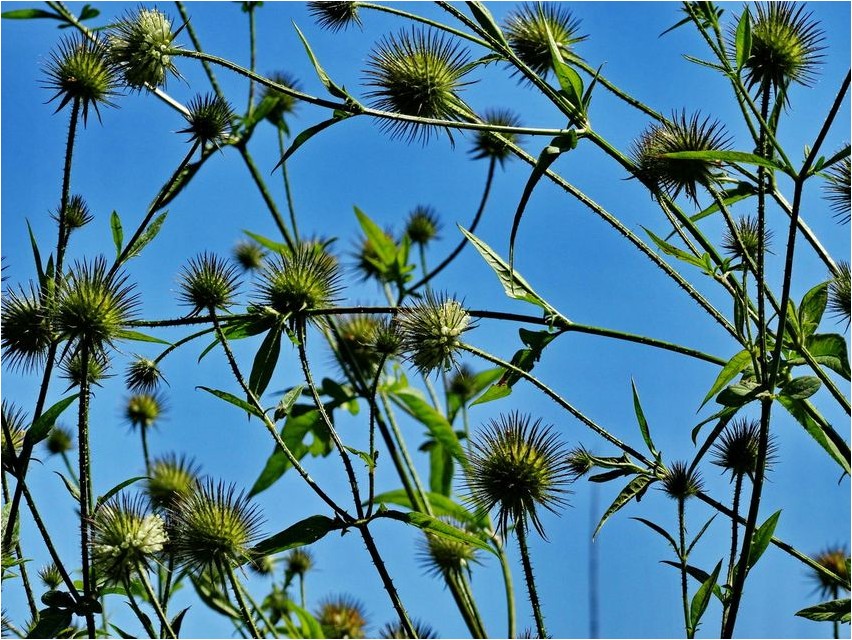
Teasel bristlecone is one of the plants in the teasel family. In Latin, the name of this plant will be as follows: Dipsacus stricosus Willd. ex Roem. et Sahult.
As for the name of the teasel family itself, in Latin it will be: Dipsacaceae Juss.
Description of teasel
Teasel bristles is a biennial herbaceous plant, the height of which can range from fifty centimeters to one and a half meters. The stem of this plant is straight, bristly and subulate. Teasel leaves are serrated and will be oblong and pointed, with the lower leaves being petiolate and entire. The stem leaves of teasel bristles will be pinnately incised at their base, with two to five lateral lobes, and also ciliated. The heads will be spherical in shape, their diameter will be about three centimeters, the involucre leaves will be pointed and lanceolate, and also significantly shorter than the head ones.
Bristle teasel blooms in June. The fruits of this plant ripen during the period from July to August. Under natural conditions, bristly teasel can be found in the Crimea, the Black Sea region of Ukraine, as well as Central Asia and the European part of Russia. To grow, bristly teasel prefers bushes at an altitude of up to 1700 meters above sea level.
Description of the medicinal properties of teasel
Teasel is endowed with quite valuable healing properties, and for medicinal purposes it is recommended to use the roots, leaves, inflorescences, and also the grass of this plant. The term grass includes stems, flowers and leaves. The presence of such beneficial properties should be associated with the fact that the plant contains flavonoids, iridoids and triterpenoids.
As for the decoction prepared from the roots of this plant, it turns out to be very effective for the treatment of syphilis and pulmonary tuberculosis. A decoction, as well as ointment and paste from the roots of teasel are used as an anesthetic for calluses, snake bites and hemorrhoids.

An infusion prepared from teasel herbs has a diuretic, anti-inflammatory, and stimulating effect on the respiratory system, circulatory system and cardiovascular system.
A decoction of the herb is recommended for ulcers and stomach cancer, as well as fevers and as a compress for skin cancer. In fact, the triterpenoid content has been shown to be low in toxicity in experiments, which has the ability to temporarily lower blood pressure. In folk medicine, a decoction of the inflorescences of the setosa teasel is recommended for rheumatism. In the textile industry, a decoction of the inflorescences from this plant is widely used for linting fabrics.
For stomach cancer, the following remedy is recommended: to prepare it, take one tablespoon of crushed dried roots of the setosa teasel per half liter of water. This mixture should be steeped for one hour, then thoroughly strained. Take half a glass of this remedy approximately three to four times a day before meals. The following remedy is recommended as a diuretic: take two tablespoons of the herb per 300 milliliters of water, simmer the mixture over low heat for several minutes, then let it steep for two hours, then strain thoroughly. Take this remedy warm, three to four times a day, half a glass at a time. This remedy should also be taken for stomach cancer and ulcers.





