Licorice
Licorice (lat. Glycyrrhiza) is a small genus of rhizomatous herbaceous perennial plants representing the legume family (lat.
Fabaceae). Plants of the genus have adapted so well to life on Earth that they are found on all continents except frosty Antarctica. The creeping thickened rhizome gives life not only to the above-ground parts of the plant, but also forms a complex system of roots in the soil. Glycyrrhizic acid contained in the roots gives them a specific sweetish taste. People use the roots and rhizomes for medicinal purposes when it is necessary to support the respiratory system affected by viral diseases.
What’s in your name
The Latin name of the genus “Glycyrrhiza” (“Licorice”) is based on two ancient Greek words, which are translated into Russian by the expression “sweet root”.
This is not an allegory, but a fact of life. The fact is that the rhizome and roots of plants of the genus have a sweetish taste. A similar taste is given to the roots by the glycyrrhizic acid they contain, the name of which clearly has the same base as the name of the plant genus, that is, the same ancient Greek words. One can only be amazed at how much Ancient Greece gave to Humanity, that for two and a half thousand years we have been constantly looking back into the past to decipher the meaning of many things, phenomena and names.
Description
From the creeping, thickened rhizome, the tap root goes deep into the earth to extract nutrients from the bowels of the Earth for the above-ground parts of the plant. In addition to the tap root, the plant forms a whole network of roots located horizontally in the soil, which become prey for people who collect medicinal plants.
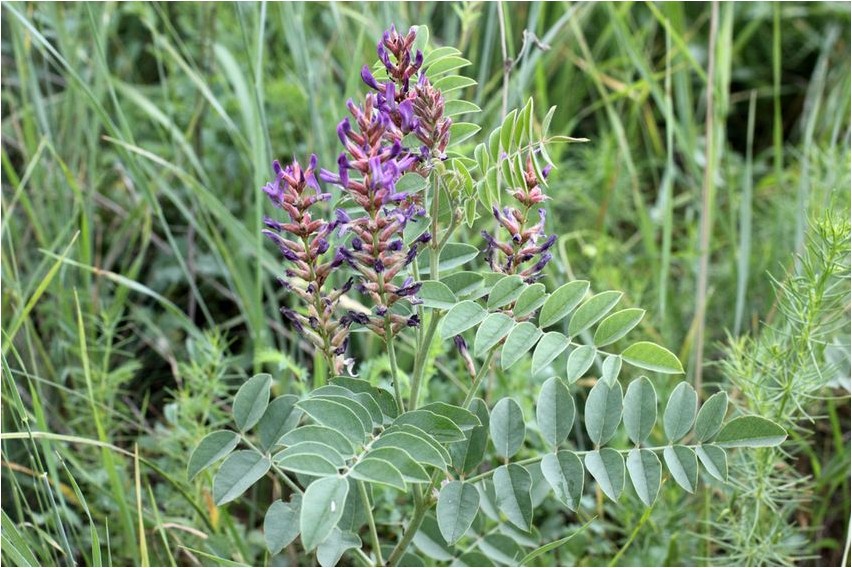
The rhizome and roots are the guarantor of the longevity of plants of the genus Licorice, displaying thin and strong erect stems on the surface of the earth. The long compound leaves, formed in pairs of pointed leaflets, make them similar to many other genera of the legume family. The leaves are often covered with a sticky coating.

In the axils of the leaves, dense inflorescences of typical moth-type flowers are born on long peduncles. The color of the flowers includes different shades of purple.
The pinnacle of the growing season is the pod bean, inside of which are hidden from one to eight seeds.
Varieties
The genus cannot boast of great diversity, numbering about twenty species in its ranks. Here are some of them:
* Licorice (lat. Glycyrrhiza glabra), also known in our country under another name, “Liquorice”.
* Goncharov’s Licorice (Glycyrrhiza gontscharovii)
* Macedonian Licorice (Glycyrrhiza macedonica)
* Three-leaf Licorice (Glycyrrhiza triphylla)
* Ural Licorice (Glycyrrhiza uralensis)
* Korshinsky’s Licorice (Glycyrrhiza korshinskyi)
* Rough Licorice (Glycyrrhiza aspera)
* Setose Licorice (Glycyrrhiza echinata)
* Bukhara Licorice (Glycyrrhiza bucharica).
Uses
Some species of the genus, such as Ural Licorice (Glycyrrhiza uralensis) and Korshinsky’s Licorice (Glycyrrhiza korshinskyi), are used medicinally to treat a number of ailments. But the most popular medicinal plant is licorice (Glycyrrhiza glabra). Its rhizome and numerous roots contain substances that can thin the mucus that clogs the respiratory tract in people with various respiratory diseases. Zlata Ognevich – Kara Licorice (Official Video)
Licorice