Lilac
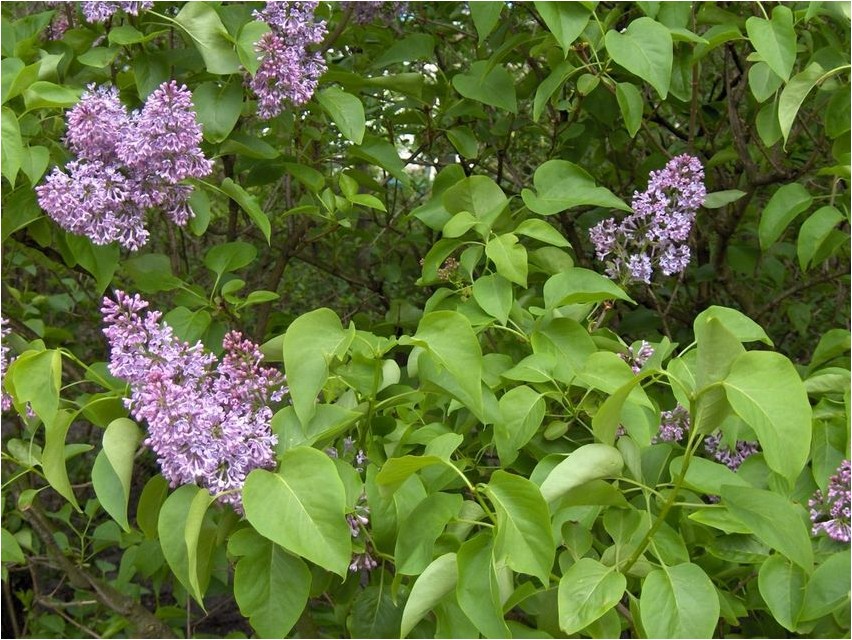
Lilac (lat. Syringa) is a genus of ornamental shrubs and trees of the Olive family. The genus includes 10 species. Under natural conditions they grow in the mountainous regions of Asia and South-Eastern Europe.
Characteristics of culture
Lilac is a multi-stemmed deciduous shrub or tree. The leaves are simple, opposite, entire, less often pinnately dissected, ovate, oval or lanceolate in shape, with pointed tips. The flowers are small, funnel-shaped, collected in paniculate inflorescences, can be lilac, purple, pink, blue, purple and even yellow, and have a pleasant aroma. The fruit is a two-leaf capsule.
Species
*Common lilac (lat. Syringa vulgaris) — the species is represented by a large shrub up to 6 m high. The leaves are heart-shaped, dense, rich green in color. The flowers are purple in color with a sweet aroma. Flowering begins in May. The species is frost-resistant, tolerates shearing well, is not picky about the soil, but has a negative attitude towards soil compaction. Common lilac is often used to create a hedge.
* Broad-leaved lilac (lat. Syringa oblata) — the species is represented by a shrub with large leaves that turn purple in autumn. Blooms in early May.

*Hyacinth lilac, or hyacinth-flowered (lat. Syringa hyacinthiflora) — the species is represented by shrubs with heart-shaped leaves, which turn brown-purple in autumn. A distinctive feature of the species is its early flowering.
*Chinese lilac (lat. Syringa chinensis) — the species is represented by large wide shrubs with an openwork crown up to 5 m high. The flowers are purple-pink in color with a sweet aroma. Blooms in mid-May. The species is light-loving, wind-resistant, and relatively winter-hardy. Prefers loamy soils with a rich mineral composition. Currently, varieties of Chinese lilac with double flowers have been developed. Very decorative look.
*Persian lilac (lat. Syringa persica) — the species is represented by shrubs with dense branches up to 3 m high. The leaves are lanceolate, pointed at the ends. The flowers are light purple in color and have a strong, specific aroma. Flowering is abundant and long-lasting, beginning at the end of May. The species is light-loving, drought-resistant, winter-hardy, and has a positive attitude towards pruning and replanting.
*Hungarian lilac (lat. Syringa josikaea) — the species is represented by large shrubs up to 4 m high. The leaves are rough, green on the outside, bluish on the bottom, becoming orange-yellow in autumn. The flowers are dark purple and have a pungent odor. Flowering begins in late May — early June. The species is frost-resistant, unpretentious. Prefers moist, acidic and slightly alkaline soils.
*Amur lilac (lat. Syringa amurensis) — the species is represented by large shrubs up to 10 m high. The leaves are bright green, heart-shaped. The flowers are small, white or cream-colored, and have a honey aroma. Flowering is abundant and long-lasting, beginning in June.
Growing conditions
Lilac is a light-loving crop; it prefers well-lit areas protected from northern winds. Lowlands with stagnant water are not allowed; the shrub also has a negative attitude toward areas that are swamped or flooded in spring and autumn. Soils for growing lilacs are preferably fertile, moderately moist, well-drained, with a slightly acidic or neutral pH. Acidic soils require preliminary liming.
Reproduction and planting
Lilacs are propagated by seeds, layering, cuttings and grafting. The seeds of the crop are collected in early October, and sowing is done in early spring. Before sowing, seeds must be stratified. Cuttings of shrubs should be carried out during the period of mass flowering. Cuttings are cut from the middle part of annual shoots. It is recommended to use perlite, river sand or a mixture of vermiculite and sand as a substrate for cuttings.
The grafting of the culture is carried out either with a dormant bud or with a cutting. It is necessary to grow grafted plants in the form of a bush, standard or semi-standard form. The formation of the trunk should begin 2-3 years after grafting. Lilacs on a trunk have a more attractive, neat and unusual appearance, but it is extremely important to regularly remove shoots from the main shoot.
It is advisable to purchase lilac seedlings from special and trusted nurseries. Seedlings with a closed root system are preferred. Lilacs are planted in the second half of July — early September, but in the evening or in cloudy weather, otherwise the crop will not take root. For the winter, young plants are mulched with peat.
Care
Lilacs need regular watering and weeding. Loosening should be carried out 3-4 times per season. In the second year of life, plants are fed with nitrogen fertilizers; phosphorus and potassium fertilizers are applied once every 2-3 years in the fall. For more abundant flowering, the crop is subjected to sanitary, thinning and formative pruning.
Application
Lilac is one of the most popular ornamental and flowering shrubs. It’s hard to imagine, but the plant has been cultivated since the 16th century. The culture is characterized by long and abundant flowering. Most often used for landscaping gardens and parks. Shrubs are used in group plantings and as tapeworms. Lilacs are also relevant in the art of creating bouquets; varieties of terry lilacs look especially impressive.
https://www. youtube. com/watch? v=1w27jWVggko