Campanula isophylla
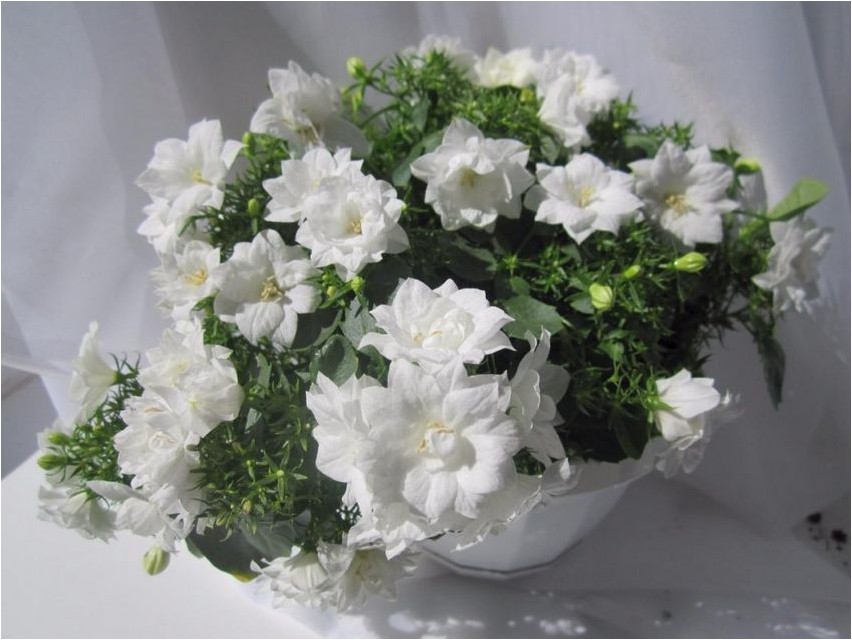
Campanula isophylla is also known as the bride and groom. The Latin name for this plant is Campanula isophylla.
Campanula isophylla belongs to the family Campanulaceae, which is also known as Campanulaceae.
Description of Campanula isophylla
For the successful development of Campanula isophylla, it requires either partial shade or full sun. During summer, the plant should be provided with ample water, while maintaining moderate humidity. Campanula isophylla is a herbaceous plant.
This plant is often found as a decorative element in common areas, as well as indoors. Campanula isophylla is grown as a stunningly beautiful miniature hanging plant. As for the maximum size in cultivation, the length of the Campanula equifolia shoots is approximately thirty centimeters.
Description of the care and cultivation of Campanula equifolia
To ensure that Campanula equifolia delights its owner with its amazing beauty, it will require regular repotting. The plant should be repotted annually, and it is recommended to choose either hanging pots or wide, yet shallow containers. As for the soil mix itself, it is recommended to combine one part sand and one part turf soil, and three parts leaf mold. The soil pH can be not only slightly acidic but also neutral.
It is important to remember that stagnant water in the pot can have an extremely adverse effect on the development of this plant. If the plant is grown in excessive shade, flowering will be quite sparse. In some cases, Campanula equifolia can be attacked by scale insects and spider mites.

Throughout the rest period, an optimal temperature should be ensured between ten and fifteen degrees Celsius. As for watering, it should be kept at a moderate level, and air humidity should remain standard. The rest period is forced if the plant is grown indoors. This dormant period begins in October and continues until February. The reasons for the occurrence of a period of rest will be not only reduced illumination, but also an insufficient degree of air humidity.
Propagation of the bellflower can occur in several ways: by rooting cuttings, dividing the bush during transplantation, and also by sowing seeds. As for the latter method, gardeners choose it much less often. Cuttings of Campanula equifolia should be rooted in a mixture consisting of sand and peat.
It should be noted that in winter it is important to keep the plant in cool and dry conditions. In this case, watering should not only be moderate, but also rare in some cases. Actually, this circumstance is explained by the fact that the plant requires a light period of rest. If in the summer the plant is located on southwestern or southern windows, then it will need additional shading. However, it is recommended to take the plant out into the open air in summer.
Not only the flowers, but also the leaves of this plant are endowed with decorative properties. The flowering of Campanula equifolia begins in the spring and continues until autumn. The flowers are painted white, blue or lilac.
How to grow a flower Bride and Groom Campanula equifolia