Calicant
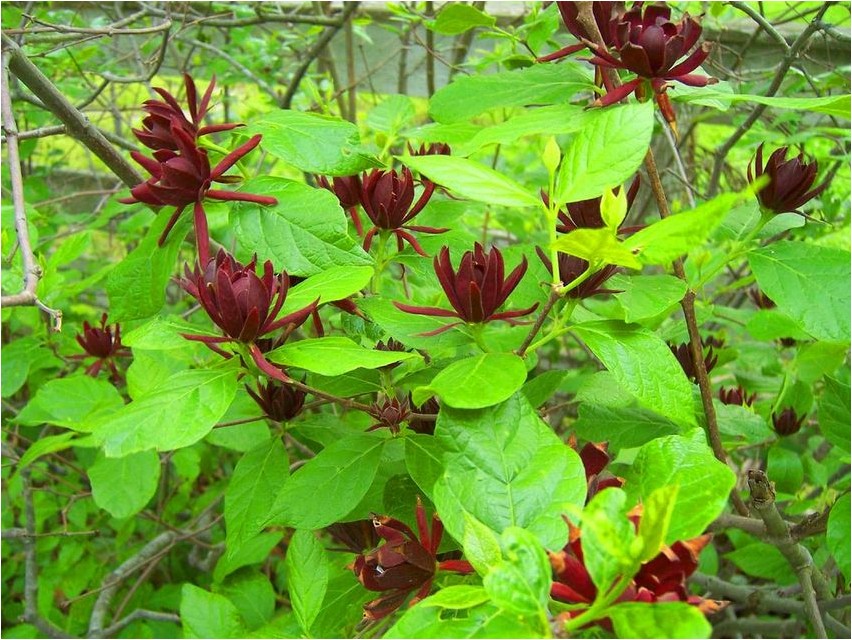
Calicanthus (lat. Calycanthus) is a genus of beautifully flowering ornamental shrubs of the Calicantaceae family. Other names are Calicanthus or Chaliceflower.
The genus has only 4 species. Plants are most common in North America.
Characteristics of culture
Calicanthus is a medium-sized deciduous shrub, the above-ground parts of which have a pleasant and persistent aroma. The leaves are large, entire, elliptical or oval, pubescent, with a rough surface, located oppositely. With age, the foliage becomes glossy, pubescence predominates on the underside. The flowers are small (up to 5-7 cm in diameter), reddish-brown, less often cream, located on short axillary shoots. The perianth consists of narrow leaflets of uniform color. The fruit is a cynorrhodium, up to 7 cm long, similar in appearance to rose hips. The seeds are small and brown.
The shrubs are distinguished by an elegant, loose crown. Calicanthus blooms profusely and for a long time, usually in early summer. In Russia, calicanthus is grown only on personal plots, and mainly in the southern regions, since the crop does not tolerate severe frosts, for which central Russia is famous. In the Moscow region and St. Petersburg, in the winter season, plants can only exist under good and high-quality shelter, otherwise they freeze out right down to the roots.
Growing conditions
For abundant flowering and normal growth, calicanthus needs intensely lit areas protected from piercing winds. In countries with hot climates, growing in semi-shaded areas is possible. The soil should be fertile, loose, light, well aerated, moderately moist and neutral.
In general, calicanthus are unpretentious and can grow on other types of soils, but abundant flowering can only be achieved on the above mentioned ones. Calicanthus develop very slowly, but if all growing conditions are met, growth accelerates.

Propagation, planting and soil preparation
Calicanthus are propagated by seeds, cuttings and dividing the bush. The most effective way is propagation by cuttings. Cuttings are cut in the spring, and before planting they are treated with a 0. 25% solution of indolyl butyric acid. With good care, plants grown from cuttings bloom within 4-5 years, sometimes earlier. The material is planted singly or in groups. The distance between plants should be about 1. 5-2 m. Calicanthus should not be planted too close, otherwise they will not be able to fully express their individuality.
The site for calicantes is prepared in advance. Before planting seedlings and other material, the soil is enriched with humus. To accelerate growth and root formation, the soil must be moistened regularly, but in moderation. Planting holes are filled 1/3 with fertile soil mixed with humus and mineral fertilizers, but the root system of a young plant should not come into contact with organic matter, as it can damage, or rather burn, the root system. You cannot use fresh manure; it is better to opt for rotted humus or compost. When planting calicanth on heavy soils, drainage is necessary. Too acidic soils are first limed with dolomite flour or well-known lime.
Care
Calicanthus need annual preventive and health-improving pruning, which consists of removing dry and damaged branches. For the winter, the plants are covered with non-woven material, for example, spruce branches, and the soil in the tree trunk circle is mulched with a generous layer of dry fallen leaves or peat. With the onset of cold weather, young plants bend to the soil surface. The shelter is removed no earlier than the fifteenth of April.
Application
Calicanthus are valued for their elegant crown, unusually beautiful color and pleasant rich aroma that will fill the entire garden and captivate even the most fastidious gardener with honey shades. Calicanthus look harmonious in group plantings, especially near recreation areas, terraces and paths. The culture combines with other flowering shrubs and herbaceous perennials, such as catnip, lavender, silver wormwood and other plants that exude rich and deep aromas.