Amaranth
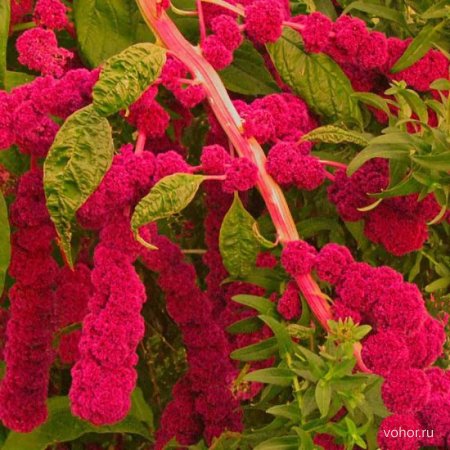
Amaranth is an annual plant that reaches a height of almost 3 m. The flower is distinguished not only by its large, obvious inflorescences in the form of a panicle, but also by its profitable properties, for which the plant is widely used in cooking.
Amaranth is easy to care for and can sprout in almost any land. It is important that the plant is provided with access to a sufficient amount of light. Therefore, the flower is planted in sunny areas. It is worth noting that the flower can withstand decreasing temperatures before 0 degrees.
Caring for flowers comes down to loosening the soil and adequate watering. The flower does not tolerate stopping water well. Weeding of the soil is carried out only at the beginning of the growing season, if the seedlings are also very small. Next, the flower outstrips all the weeds in growth, which destroys them. When amaranth is grown for the purpose of being used as food, then it is better not to pay for mineral fertilizers. Growing the plant in white decorative trays requires fertilizing with potassium fertilizers at the beginning of growth.
Types of amaranth
1. Paniculata
2. Dark
3. Tri-color

4. Tailed

care and cultivation of amaranth
Amaranth is easy to care for and can sprout in almost any land. It is important that the plant is provided with access to a sufficient amount of light. Therefore, the flower is planted in sunny areas. It is worth noting that the flower can withstand decreasing temperatures before 0 degrees.
Caring for flowers comes down to loosening the soil and adequate watering. The flower does not tolerate stopping water well. Weeding of the soil is carried out only at the beginning of the growing season, if the seedlings are also very small. Next, the flower outstrips all the weeds in growth, which destroys them. When amaranth is grown for the purpose of being used as food, then it is better not to pay for mineral fertilizers. Growing the plant in white decorative trays requires fertilizing with potassium fertilizers at the beginning of growth.

reproduction
amaranth is propagated by grains, which are sown in mid-May immediately in the open ground. Before sowing, the land is prepared by adding organic fertilizers. Grains are allowed to be thrown before winter. The grains are planted at a distance of 1. 5 cm and at a distance of almost 15-20 cm. Amaranth can be propagated using the seedling method. In this case, grains are placed in peat pots in two or three pieces in April. The grains germinate at room temperature. Subsequently, as soon as the seedlings become stronger, the seedlings are hardened off before planting in official soil. For this reason, plants are gradually brought to an air temperature of 10-12 degrees. In general, seedlings are planted in early June, preferably at the end of the day, if it is not unreasonably hot. Amaranth is planted in front of a small slope at a distance of almost 40 cm. Confidant through a friend. Young plants are subsequently planted in shade and watered a lot. To increase branching, the tops of plants are pinched at the end of June.
Diseases and pests
Amaranth is resistant to pests and diseases, but can sometimes suffer from aphids and other fungal diseases due to excess moisture.