Lokva
Lokva (lat. Eriobotrya japonica) is a fruit crop that is an excellent autumn honey plant and belongs to the Rosaceae family. Its other names are shesek (shasik), Japanese medlar, Japanese eriobothrya and nispero.
Description
Loqua is an ornamental fruit plant whose height can reach eight meters. Both its shoots and its inflorescences are colored in reddish-gray tones — this color is due to the thick felt pubescence. And the oval whole leaves of loquat reach a width of seven to eight centimeters and a length of twenty-five centimeters. They can be either sessile or equipped with short petioles. Each leaf blade is pubescent from below, and from above all the leaves shine very impressively.
The diameter of loqua flowers is on average one to two centimeters, with all the flowers closer to the ends of the shoots folded into graceful erect panicles. Each flower includes five yellowish or white petals, and you can admire their bloom only in September or October. If loqua is grown in a temperate climate, then it will traditionally bloom in the spring, and the ripe fruits can be harvested in autumn.
By the way, loquat flowers boast an incredibly pleasant smell, something similar to the aroma of almonds — this property is highly valued by true perfume connoisseurs. It is also important to know that if you stand near flowering trees for too long, you can get quite a headache.
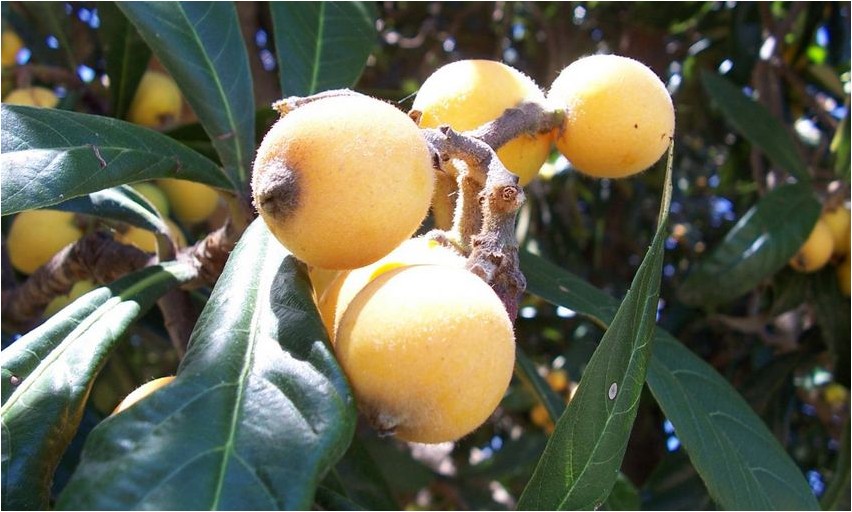
With the onset of spring, mature trees are abundantly covered with yellow-orange pear-shaped fruits collected in clusters, each of which contains from one to eight fruits. The juicy pulp of the fruit includes from one to five fairly large seeds, which occupy a fairly significant part of their total volume. The pulp can be either orange, yellow or white. Loquat fruits are very tasty, sweetish-sour and somewhat reminiscent in taste of cherries or juicy pears. But in terms of the chemical composition, loquat is close to apples.
Where does it grow
The homeland of this crop is the humid subtropics of China and Japan, where it grows mainly on picturesque mountain slopes. Loquat first came to Europe only in the nineteenth century. Now you can easily find it in the Caucasus (especially south of Tuapse, where lokva can be seen right on the city streets) and in the Crimea — you can enjoy the fruits of the new harvest in these regions as early as May.

Application
Edible loquat fruits are very rich in vitamin A and potassium, which gives them a pronounced diuretic effect. Taking part in the water-electrolyte balance, potassium helps remove excess fluid from the body, regulates the heart rate and facilitates the work of the heart. It is especially advisable to use lokva for dropsy, heart failure, arrhythmia or hypertension.
Lokva is very rich in pectin, which means it makes delicious marmalade and jelly, and the jam made from it is so thick that it doesn’t slide off sandwiches at all. This fruit is also used to make excellent wine.
Contraindications
In general, loqua is quite safe, so it has no serious contraindications. True, even though it is practically non-allergenic, the possibility of individual intolerance cannot be ruled out. The main thing is not to eat the leaves and seeds of loquat, as they contain cyanide glycosides that are dangerous to humans.
Growing and care
Lokva is very moisture-loving, but at the same time very frost-resistant: it can tolerate not only light frosts, but also a drop in temperature to minus fourteen degrees. It grows mainly in humid subtropical climates, but it is quite possible to grow it in the temperate zone (in areas as close as possible to the border with the subtropics). By the way, lokva can be grown not only in open ground, but also in the most ordinary indoor conditions.
Each loquat tree can produce up to seventy kilograms of fruit, and if weather conditions are particularly favorable, the yield from one tree can reach three hundred kilograms.