Genipa
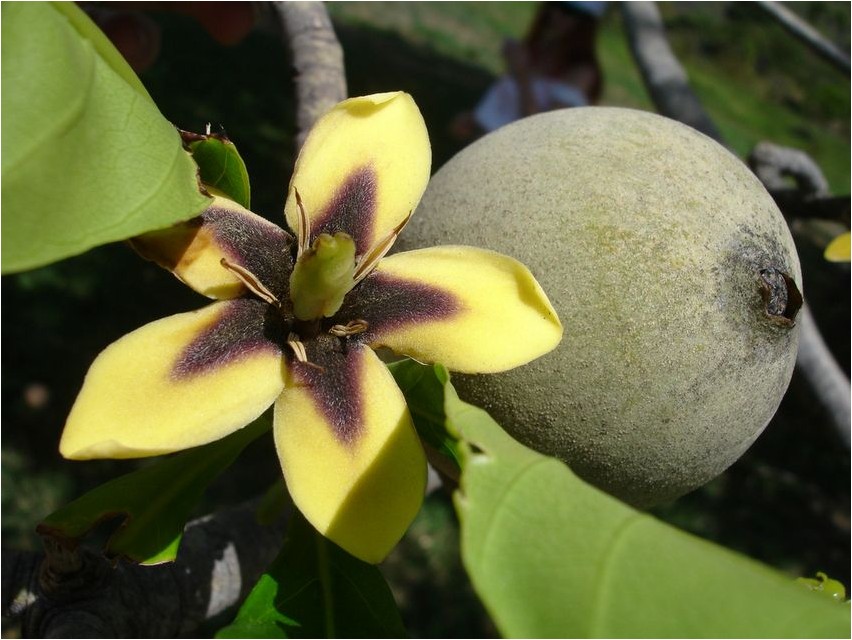
Genipa (lat. Genipa americana) is a fruit tree belonging to the Rubiaceae family.
Description
Genipa is a woody deciduous plant whose height ranges from eighteen to thirty-three meters.
The oval leaves of the genipa are slightly serrated along the edges. Their width ranges from four to thirteen centimeters, and their length from ten to thirty-three centimeters. In the very center of each leaf, the main vein, painted in whitish tones, clearly stands out.
The diameter of the rather large yellow, red or white genipa flowers is approximately five to six centimeters. All flowers have five identical petals.
The oval genipa fruits reach a length of nine to fifteen centimeters and a width of seven to nine centimeters. All fruits are endowed with a rather thick skin, and their aromatic and sweet cream-colored pulp gradually turns yellow upon contact with air. The British, who first tried genipa, began to call it “marmalade box”.
Where does it grow
The genipa is native to the islands of the Caribbean archipelago, as well as the northern part of South America, Central America and the southern part of North America. In addition, this crop has long been cultivated in the Philippines. It is noteworthy that it is impossible to find a genipu at an altitude of more than a thousand meters above sea level.

Application
Genipa fruits are suitable for eating only when overripe — only in this case are they soft enough. However, jams, jams, preserves, as well as compotes and juices are most often prepared from these fruits. They are also added to ice cream and sherbet.
In Puerto Rico, the genipa fruit is cut, then filled with water and allowed to ferment. As soon as the fermentation process begins, various flavors are added to the composition. This infusion perfectly tones the body and perfectly quenches thirst.
Genipa compote is an excellent expectorant for sore throats, bronchitis and colds. And thanks to the high content of ascorbic acid, phosphorus and calcium, these fruits have a rejuvenating effect and have a general strengthening effect. The juice of these fruits has a diuretic effect, and local residents often use them as a means to get rid of worms (helminths) and jaundice.
A decoction of genipa bark and its unripe fruits are used in Central American countries as a traditional medicine — they are used to treat sexually transmitted diseases and pharyngitis. In addition, a decoction of the roots is a fairly strong laxative. And since the bark contains a fairly large amount of tannin, it is excellent in curing skin diseases of an infectious nature. If you slightly cut the bark, a sweet, whitish resin will begin to release from it, which has a powerful disinfectant effect. This resin is diluted with water and the eyes are washed with the resulting composition.
The juice of genipa leaves is quite actively used in Central American countries as an antipyretic. A decoction of flowers can also be used for the same purpose; moreover, it perfectly tones the body.
Unripe genipa fruits are often used in fishing as bait to attract aquatic life. And the juice of unripe fruits oxidizes very quickly in air, turning dark blue. This property makes it possible to obtain from it a dye used by American Indians for applying body designs. By the way, this paint has a fairly high durability — it does not wash off for fifteen to twenty days.
Growing
Genipa grows very quickly — when it reaches three years of age, it is already possible to harvest the first harvest. In most cases, it bears fruit once a year, but there are also varieties that produce crops all year round. This crop tolerates waterlogging very easily and prefers temporarily flooded (alluvial) soils.
Genipa is also very thermophilic — even with the slightest frost it dies almost immediately.





