Davidsonia
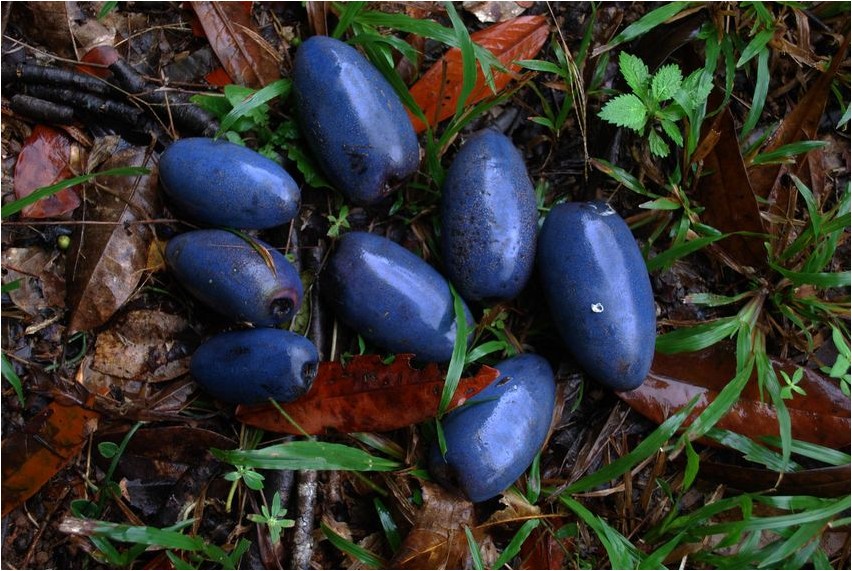
Davidsonia (lat. Davidsonia) is a whole genus of plants belonging to the Cunoniaceae family, which includes three species of trees.
Description
Davidsonia is a small and very slender tree, with an average height of five meters. Its young leaves are usually painted in bright pinkish shades, while older leaves boast a rich green color. All leaves of Davidsonia are usually dissected and leathery.
The sour fruits of Davidsonia are very similar in shape to plums. And their color is also purple, and their diameter can reach five centimeters. The fruit pulp is always bright (dark red) and juicy. In addition, each fruit can contain one or two seeds. As a rule, the ripening period for these fruits occurs at the end of summer.
Currently, there are three varieties of Davidsonia — Davidsonia pruriens, Davidsonia johnsonii and Davidsonia jerseyana. All three varieties are listed in the Red Book, as they are on the verge of extinction.
Davidsonia pruriens is the slenderest and tallest tree: its height often reaches twelve meters. It has excellent productivity, produces the largest fruits and is often grown as a cultivated plant.
Davidsonia johnsonii is characterized by an expanded crown. But it cannot boast of high productivity, so it can be found extremely rarely in culture.

Davidsonia jerseyana is a fruit tree whose height rarely exceeds five meters. It is quite actively cultivated to obtain tasty edible fruits.
Unfortunately, Davidsonium and its chemical composition have so far been very poorly studied.
Where does it grow
Davidsonia grows primarily in Australian rainforests.
Application
The fruits of this crop are quite actively used for making ice cream, preserves, wines, jams and juice. All preserves are prepared with a large amount of sugar. In addition, Davidson pulp is added to yoghurts, sauces and salads. And this fruit is practically not consumed fresh — the reason for this is that the taste of the fruit is too sour.
Quite often, Davidson is also used as a flavoring agent for poultry dishes. However, the most popular way of processing it has been and remains the production of wines and liqueurs.
Davidsonia is characterized by pronounced antioxidant properties — in this respect it is quite comparable to blueberries. As for its calorie content, 100 grams of fruit contains about 64 kcal.
Davidsonia has also found application in cosmetology—its fruit extract is used in cosmetics as a valuable antimicrobial agent that combats acne, as well as a rejuvenating ingredient. It also soothes and nourishes the skin. Furthermore, the fruit extract can significantly reduce UV-related skin damage and significantly promotes elastin and collagen synthesis, which in turn naturally improves skin elasticity and firmness. The anthocyanins contained in Davidsonia fruits have pronounced anti-inflammatory properties.
Contraindications
The only contraindication to consuming Davidsonia fruits is currently individual intolerance.
Cultivation
The optimal temperature for the successful growth and fruiting of Davidsonia is considered to be between 18 and 25 degrees Celsius. Incidentally, this plant is distinguished by good shade tolerance. It is propagated either by suckers or seeds.
https://www. youtube. com/watch? v=GhXy7LpgyBk





