Cycnoches
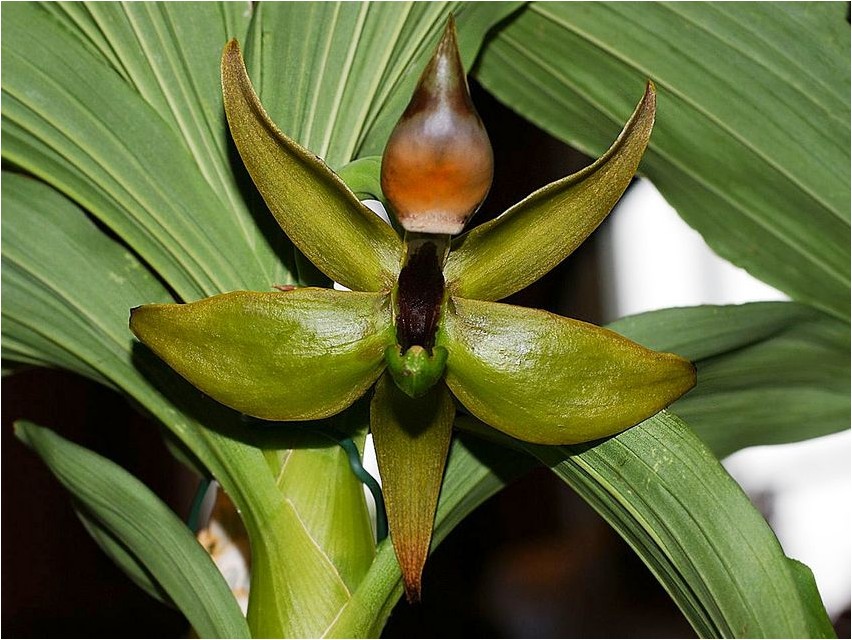
Cycnoches (Latin: Cycnoches) is a genus of herbaceous perennial epiphytic plants belonging to the orchid family (Latin: Orchidaceae).
Plants of the genus Cycnoches are unique in the orchid family, as their flowers are divided into male and female. Only in rare cases can flowers of this genus be hermaphroditic, that is, bisexual, as in most orchids.
What’s in a name
The Latin name of the genus “Cycnoches” is derived from two Greek words, which translated into English mean “swan” and “neck.” The genus owes this name to the male flowers of the plants, or rather, to the part of the flower known by botanists as the “column,” which is shaped like a swan’s neck. A single specimen of this genus was brought to Europe from northeastern South America and described by the orchid expert John Lindley (1799–1865), who also described plants of the genus Chysis and other members of the Orchidaceae family.
In horticultural literature, the genus name is abbreviated to three letters, known as “Cyc.”
Description
Plants of the genus Cycnoches are epiphytic plants that grow on trees in warm, humid tropical forests located at elevations of 1, 500 meters above sea level.
The plants have spindle-shaped pseudobulbs with several nodes and three to seven pairs of thin, veined leaves with pointed tips. New leaf shoots can emerge from almost any node on the pseudobulb. After approximately six months, they reach maturity, and then flowers appear. After flowering, leaves often fall off, followed by a period of rest until new growth begins.

Pendulous inflorescences emerge from the upper nodes of the pseudobulb. The uniqueness of the inflorescences of the genus Cycnoches lies in their separate male and female flowers, with only occasionally occurring hermaphroditic, intermediate flowers, as in other orchid species.
Determining the sex of a flower is very easy. The column of a male flower is thin, long, and curved, like a swan’s neck, hence the name of the genus. Pollinia are clearly visible at the tip of this column. The female column is relatively short and has hook-shaped, curved structures on each side. The stigma is located within the column.
Generally, male flowers come in two types. The first type, called “Cycnoches,” is characterized by a general similarity in the appearance of the male and female flowers, but differs in the columnar structure. The second type, called “Heteranthae,” is characterized by a radically different male flower from the female flower. While the female flowers of the second type are identical to those of the first type, only typically slightly smaller, the male flowers are small and have a disc-shaped lip with projections or “fingers” numbering from 5 to 14.
Flowers of the genus Cycnoches are pollinated by bees, which they attract with a pleasant, strong aroma.
Varieties
The genus consists of eight (8) species of plants of the first type, called “Cycnoches,” and approximately 25-28 species of plants of the second type, called “Heteranthae.” As of July 2009, the World Monocot checklist contained 39 species in the genus. * Cycnoches loddigesii is the type species of the genus.
The following species of the genus Cycnoches are also popular in floriculture:
* Cycnoches chlorochilon
* Cycnoches haagii
* Cycnoches pentadactylon
* Cycnoches barthiorum.
Growing Conditions
Plants of the genus Cycnoches, being epiphytic plants of the humid and warm tropics, require conditions typical of tropical orchids: warmth, humidity, and high light. Humidity should not be confused with dampness, which can cause various rots. Plants can also be affected by spider mites.
ORCHIDS. Flowering and Changes in Cycnoches. Why is there only one pseudobulb left? / Cycnoches Chlorochilon.
Cycnoches cycnoches


