Harelip intoxicating
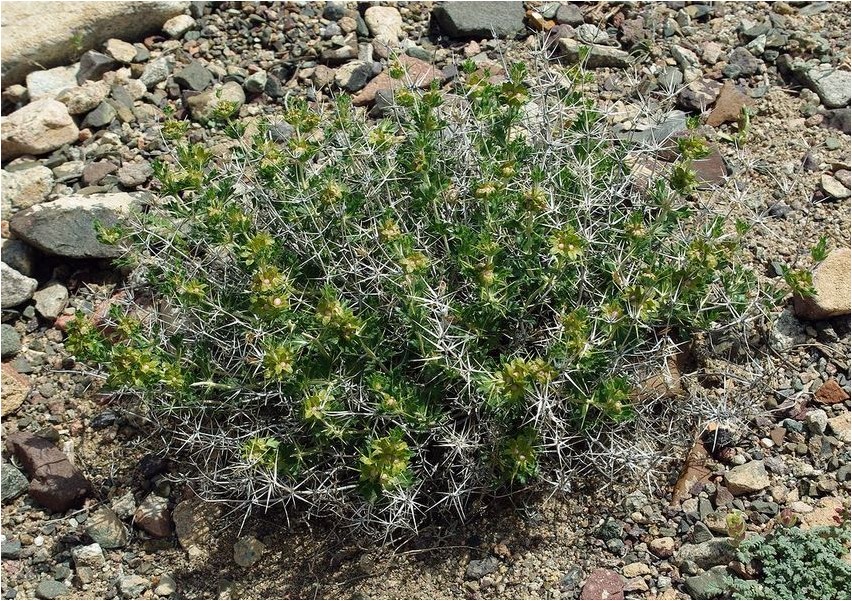
The intoxicating harelip is one of the plants of the family called Lamiaceae; in Latin the name of this plant would be as follows: Lagochilus inebrians Bunge.
As for the name of the intoxicating harelip family itself, in Latin it will be like this: Lamiaceae Lindl.
Description of the intoxicating harelip
The intoxicating harelip is a subshrub whose height will be about twenty-four to sixty centimeters. Such a subshrub is endowed with a tap root and quite numerous erect simple or branched prickly stems. The leaves of this plant are on petioles, they will be slightly leathery and opposite, at the base such leaves are wedge-shaped, they are three to five-parted, endowed with rounded and sometimes even incised lobes. The flowers are in whorls, they will be two-lipped and painted in pale pink tones. The fruit of the intoxicating harelip consists of four oblong brown nuts, which, after ripening, are enclosed in the remaining calyx.
The intoxicating harelip blooms from June to September.
Description of the medicinal properties of the intoxicating harelip
The intoxicating harelip is endowed with very valuable healing properties, and for medicinal purposes the flowers and leaves of this plant should be harvested throughout the entire flowering period. To do this, you need to dry such parts of the plant on a tarpaulin or on clean clay areas. Flowers and leaves of the intoxicating hare should be collected for medicinal purposes. Under natural conditions, this plant is found in Tajikistan and Uzbekistan.
The presence of such valuable healing properties is explained by the content of lagochilin in the leaves and flowers, which is a tetraatomic alcohol. The leaves of this plant contain tannins, sugar, essential oil, ascorbic acid, carotene, organic acids, calcium salts, trace elements, vitamin K, as well as flavonoids, from which hyperoside and rutin are derived.

Preparations based on this plant are recommended for use for a variety of bleeding: nasal, pulmonary, juvenile, traumatic, hemorrhoidal, as well as bleeding due to uterine fibromatosis, in addition, drugs are also used to prevent bleeding before surgery. Such drugs are also taken for hemophilia, Werlhof’s disease and other hemorrhagic diathesis, in the treatment of eczema, nettles, neurodermatitis and lichen planus.
An infusion of intoxicating harelip is recommended to be prescribed orally for glaucoma, in the complex treatment of patients with rheumatism to reduce capillary permeability, as well as to reduce the hypocoagulating effect of salicylates. In addition, this infusion of this plant is also used as a desensitizing agent. It is noteworthy that it has been proven that preparations based on this plant are capable of increasing performance and endurance in conditions of both increased solar radiation and also in conditions of high temperature.
Positive results are also observed when using drugs based on intoxicating harelip in patients with functional diseases of the central nervous system. This effect should be associated with the sedative effect of this plant, which will result in improved sleep, and the complete disappearance of effective excitability, tearfulness and other symptoms. As a sedative, an infusion of the leaves of this plant is recommended to be taken one tablespoon three to six times a day. This infusion is prepared in a ratio of one to ten or one to twenty.





