Cotoneaster aronia
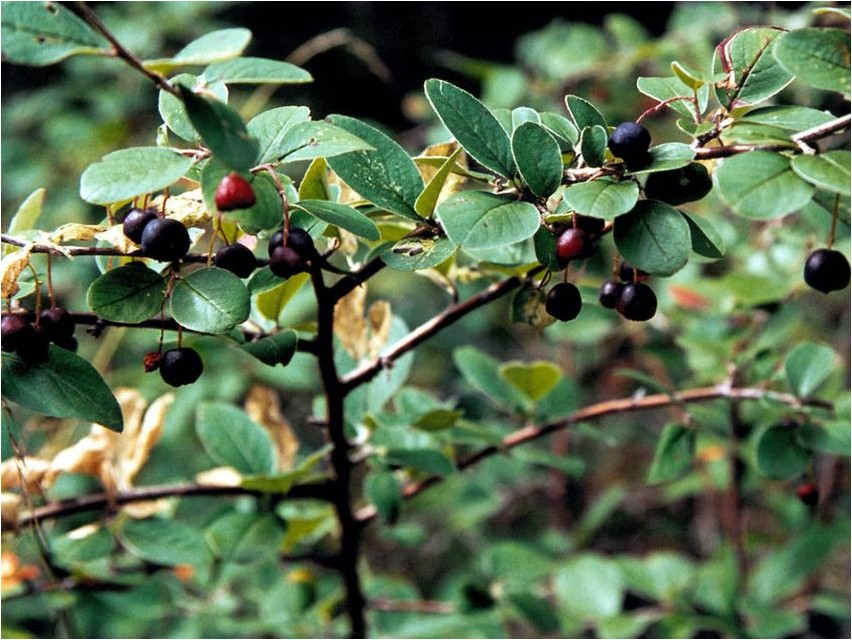
Cotoneaster aronia is one of the plants of the family called Rosaceae; in Latin the name of this plant will be as follows: Cotoneaster melanocarpus Fisch. ex BIytt (C. nigra Regel, C. vulgaris Ledeb.).
As for the name of the cotoneaster family itself, in Latin it will be: Rosaceae Juss.
Description of cotoneaster
Chokeberry cotoneaster is a shrub whose height can range from fifty centimeters to four meters. It is noteworthy that this plant is perennial. The leaves of this plant are on rather short petioles, they will be ovate in shape, on top such leaves are painted in dark green tones, and below they will be whitish-felt. The flowers are found in about five to fifteen pieces in drooping racemes or in corymbose panicles. The length of the cotoneaster aronia fruits will be about seven to nine millimeters; mature fruits will be colored black and endowed with a bluish bloom.
Chokeberry cotoneaster blooms in June, fruiting will occur in September. Under natural conditions, this plant is found in the European part of Russia, Ukraine, the Far East, the Caucasus, Central Asia, the European Arctic, as well as Western and Eastern Siberia. As for its general distribution, this plant is found in China, Japan, Northern Mongolia and Central Europe. For growth, the plant prefers limestone outcrops, rocks, forests, bushes, cliffs, from the foothills to the upper mountain belt. The plant can grow either singly or in small groups.
Description of the medicinal properties of cotoneaster
Black cotoneaster is endowed with very valuable healing properties, and it is recommended to use the fruits and branches of this plant for medicinal purposes.
The presence of such valuable properties is explained by the content of prunasin in the branches, while the leaves contain flavonoids, catechins, vitamin C, anthocyanins, phenolcarboxylic acids and their following derivatives: chlorogenic and isochlorogenic acids. The fruits of black cotoneaster contain anthocyanins, vitamin C, flavonoids, macro- and microelements. It should be noted that the leaves, flowers, buds and bark of this plant are endowed with very valuable antibacterial properties.

As for traditional medicine, the resin of the branches of this plant after dry distillation is used for scabies and eczema. A decoction prepared from the fruit is recommended for use against dysentery, sepsis and numerous infectious diseases, as well as flatulence. It should be noted that the fruits of black cotoneaster are edible after frost.
For the flu, it is recommended to use the following remedy based on cotoneaster: to prepare such a remedy, you will need to take five tablespoons of the fruits of this plant in half a liter of water. The resulting mixture should be boiled for seven to eight minutes, then this mixture is infused for two hours, after which this mixture is filtered very carefully. The resulting remedy based on cotoneaster should be taken one-third of a glass three to four times a day before meals. It is noteworthy that in order to achieve the greatest effectiveness when taking such a remedy based on cotoneaster, you should strictly follow not only all the standards for the preparation of such a remedy, but also carefully follow all the rules for its administration. It is worth noting that it is possible that new ways of using the medicinal properties of aronia cotoneaster may emerge.





