Colocasia edible
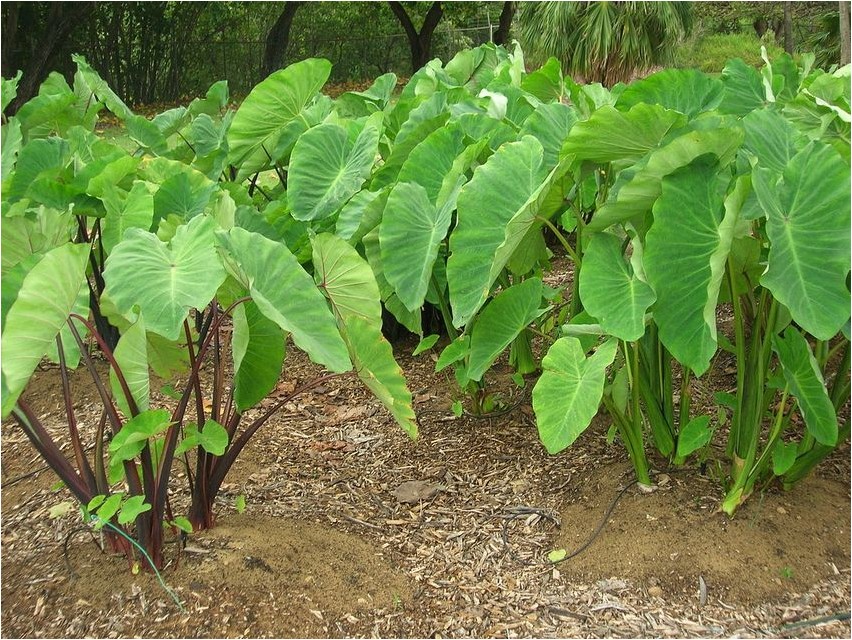
Edible colocasia is also known as colocasia taro; in Latin the name of this plant is as follows: Colocasia esculenta.
Colocasia edible is one of the plants of the family called araceae; in Latin the name of this family is Araceae.
Description of edible colocasia
For the favorable development of this plant, it will be necessary to provide it with either a light regime of partial shade or a light regime of full shade. Throughout the summer, edible colocasia will need to be watered abundantly, and the air humidity should be kept at a fairly high level. The life form of edible colocasia is a herbaceous plant.
This plant is quite often found in winter gardens, where it is grown as a large planter. It is believed that edible colocasia is considered an overly large plant for indoor conditions. As for the maximum size in culture, the height of this plant can be from one to five meters, while the diameter of the edible colocasia will be about three meters.
Description of the features of care and cultivation of edible colocasia
It should be noted that for the favorable cultivation of edible colocasia, regular transplants will be required. Such transplants should be carried out in the spring, and it is recommended to select larger pots. As for those plants that grow very quickly, they need to be replanted twice a year, but it is important to avoid the slightest damage to the earthen clod. To transplant this plant, the following composition of the soil mixture is required: one part of peat, humus, leaf soil and half of sand. The acidity of such soil should be slightly acidic.
When a plant receives insufficient air humidity, its young leaves may become deformed. However, if the watering is excessive, and fairly frequent spraying is also carried out, spots colored in yellow-brown tones will appear on the leaves of the edible colocasia. In order to increase the degree of air humidity, you will need to wrap the lower part of the stem of the colocasia with an edible plant using a spider mite. Spider mite damage occurs when there is excessively low air humidity.

Throughout the entire rest period, it is necessary to maintain an optimal temperature of about fifteen degrees Celsius. At the same time, watering edible colocasia is necessary rarely, and air humidity can remain standard.
It should be noted that in winter, from October to February, this plant can be maintained in two ways. The first way is to keep the tubers of this plant without any watering. The second method is to reduce watering and keep the colocasia leaves edible.
Reproduction of this plant can also occur in two ways: through daughter tubers or through root suckers. As for the second method, the formation of such offspring occurs at the very base of the short, but at the same time thickened stem of this plant. In this way, propagation should be carried out either in the spring or in the summer.
Edible colocasia must be watered with warm and soft water, and air humidity should always be maintained at approximately seventy-five to eighty percent. It is important to remember that throughout the winter season this plant will also require additional lighting so that the plant receives light for twelve hours a day.