Malay apple
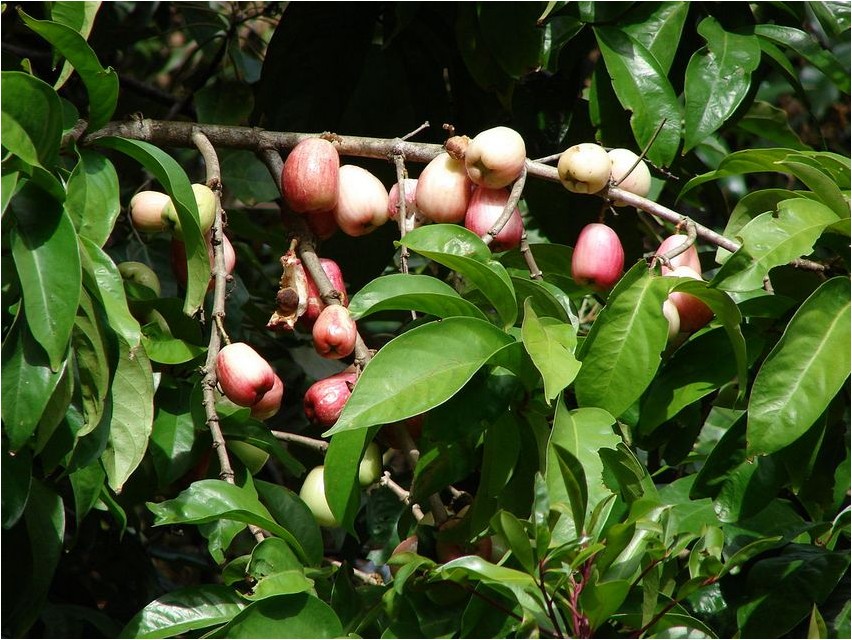
Malayan apple (lat. Syzygium malaccense) is a fruit crop belonging to the Myrtaceae family and is often called iambosa.
Description
Malayan apple is a slow-growing and evergreen fruit tree, endowed with magnificent pyramidal crowns. Typically, the height of mature trees ranges from twelve to eighteen meters. The leathery, dark green leaves of the Malaya apple have an elliptical-lanceolate shape. They are glossy above and light green below. At the same time, all young leaves can boast of a pleasant reddish color. The width of the leaflets ranges from nine to twenty centimeters, and the length ranges from fifteen to forty-five centimeters.
As for the flowers of the Malayan apple, they can have a wide variety of shades: whitish, yellow, dark red or pinkish-violet. Their diameter most often varies from five to seven and a half centimeters, and they all form intricate clusters located either on mature branches or on the tops of trunks. Among other things, these flowers boast a pleasant, subtle aroma.
The bell-shaped or oblong fruits of the Malayan apple grow from five to ten centimeters in length and from two and a half to seven and a half centimeters in width. By the way, in shape they somewhat resemble the well-known pears. The top of each fruit is covered with a waxy skin, which can be either dark red or pink-red, or almost white, with small reddish or pinkish stripes. The flesh of the Malay apple is crispy and very juicy. It is painted white and boasts a surprisingly sweet, enchanting aroma. Almost always in the center of the fruit you can find one or two large brown seeds, but from time to time you can also find fruits without seeds at all.
Where does it grow
Malaysia is considered the birthplace of the Malay apple, but this crop has been grown since ancient times on a number of Pacific islands, as well as in India and some other countries in Southeast Asia. In the sixteenth century, enterprising Portuguese brought the Malayan apple to distant East Africa, and already in 1793 it appeared in Jamaica, from which it subsequently began to actively spread to the countries of South, Central and North America.
Application
The fruits of this interesting plant can be eaten fresh—they are delicious and nutritious. Locals often stew them with cloves or a variety of other spices. Unripe fruits are also used: they make excellent marinades and delicate jelly. In some countries (Puerto Rico, etc.), Malayan apples are also used to make excellent red or white wines. Indonesians also add the flowers of this plant to salads or enjoy boiling them in a special syrup.

This fruit boasts an abundance of beneficial substances. It is widely used to treat a wide variety of respiratory ailments, lower cholesterol, and normalize blood pressure.
A decoction of the roots of this unusual plant is an excellent diuretic, and a decoction of its bark is widely used for stomach upsets and diarrhea. Moreover, a decoction of the roots boasts a pronounced diuretic effect, making it an indispensable aid in the treatment of infectious ailments of the genitourinary system, as well as cardiovascular and kidney diseases. Freshly squeezed fruit juice is actively used externally, as it helps relieve a wide range of skin ailments.
These fruits are especially prized as a medicinal remedy in Brazil—in this sunny country, they are used to make highly effective remedies for diabetes, headaches, coughs, pulmonary catarrh, constipation, and more.
And in some countries, the Malayan apple is considered a cult plant—its flowers are an integral attribute of sacrificial rites to the gods, and idols are carved from its wood.
Contraindications
When consuming the Malayan apple, it is a good idea to be aware of any individual intolerances, as some of its substances can cause allergies.