Peony milky-flowered
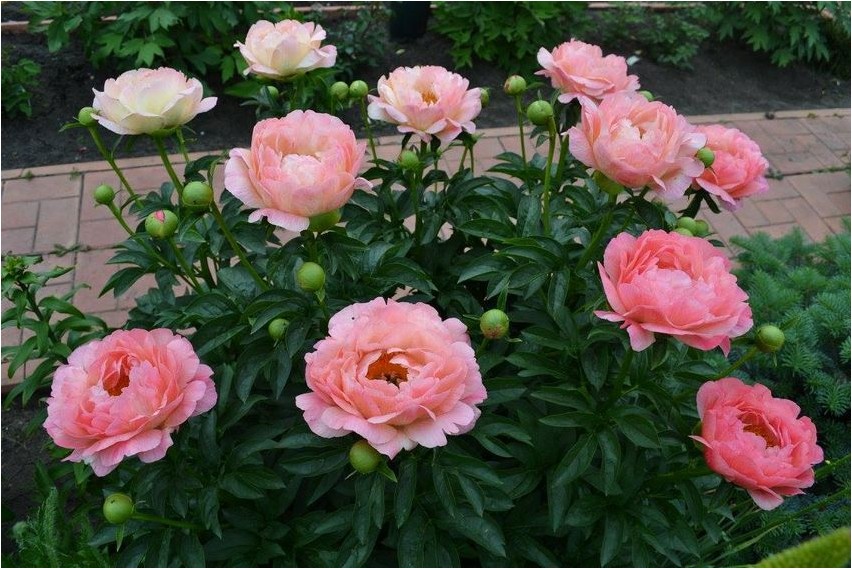
The milky peony is one of the plants of the family called peony, in Latin the name of this plant will be as follows: Paeonia lactiflora Pall. (P. albiflora Pall.).
As for the name of the milky peony family itself, in Latin it will be: Paeoniaceae Rudolphi.
Description of the milky peony
The milky peony is a perennial herbaceous plant, the height of which will fluctuate between sixty and one hundred centimeters. The root thickenings of this plant are spindle-shaped and are colored brown. The stems of the milky peony are bare; they can be endowed with one or several flowers. The leaves of this plant will be double-triple, with the leaf lobes petiolate, and the lateral ones will be sessile; in shape they can be either elliptical or lanceolate. For the most part, such leaves will be pointed, while some bracts of this plant can be either whole or leaf-shaped and separate. The flowers of the milky peony are painted in white or red, the length of the petals will be about five to eight centimeters, and the stamens themselves will be golden yellow in color. There are only three to six fruits of this plant; they are oval in shape and black in color.
The milky peony blooms in May, while the seeds ripen in October. Under natural conditions, this plant is found in Primorye, Amur region and Eastern Siberia.
Description of the medicinal properties of peony lactiflora
The milky peony is endowed with very valuable healing properties, and it is recommended to use the roots and rhizomes of this plant for medicinal purposes. The presence of valuable healing properties is recommended to be explained by the content of flavonoids in the composition of this plant, while the roots will contain alcohols, resins, tannins, steroids, triterpenoids, quinones, essential oil, salicylic acid, methyl salicylic alcohol and benzoic acid. The leaves of the peony lactiflora contain ascorbic acid, while the flowers contain the following flavonoids: ranunculetin, quercetin, kaempferol and flavescetin, and the petals contain tannins, cyclopentane and its derivatives.
The rhizomes of this plant are recommended for use as an anti-inflammatory, anticonvulsant, and analgesic. They are also used for stomach ailments, nephritis, leucorrhoea, hypertension, cancer, diabetes, various gynecological conditions, and for the treatment of infectious hepatitis and retinal hemorrhages.

A decoction made from the rhizomes of the Paeonia lactiflora is recommended as a diuretic, sedative, expectorant, and lactogenic agent. It is also used for various menstrual irregularities, gastritis with decreased gastric secretion, liver disease, dysentery, diarrhea, as an appetite stimulant, and a tonic.
In Tibetan medicine, this plant has found quite wide application. A decoction made from the rhizomes of this plant is indicated for bronchitis, pneumonia, tuberculosis, and various colds in combination with other medicinal products. An infusion made from the rhizomes of the milky-flowered peony has a very effective sedative effect. An alcohol extract of the rhizomes of this plant is used for posthemorrhagic anemia, and the root powder is used in an ointment for bone fractures.
Peony taxonomy: species, arborescent, herbaceous milky-flowered, early-flowering