Centaury small
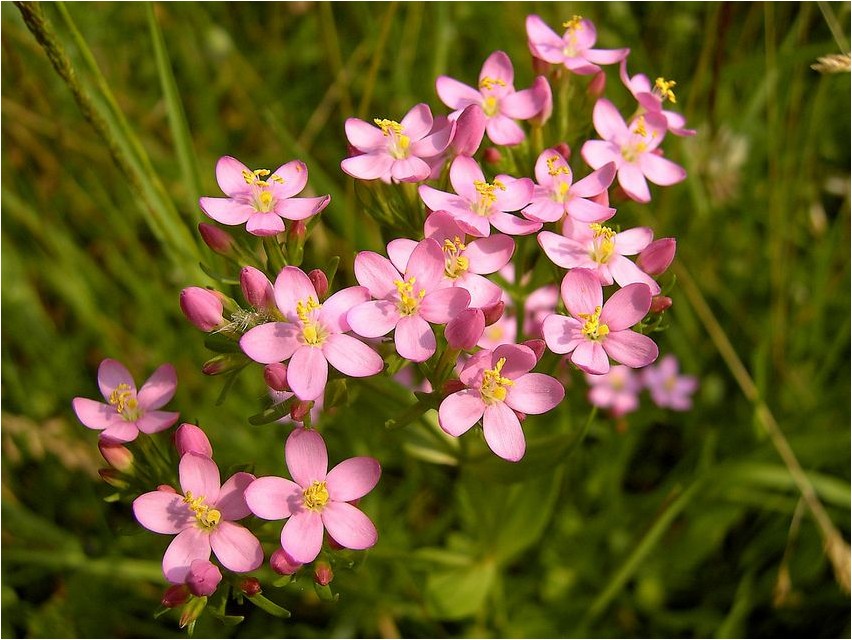
Small centaury is one of the plants of the family called Gentianaceae; in Latin the name of this plant will be as follows: Centaurium erythraea Rofn.
As for the Latin name of the small centaury family, in Latin it will be: Gentianaceae Juss.
Description of centaury small
Small centaury is a biennial or annual herbaceous plant, the height of which will fluctuate between fifteen and forty centimeters. The stems are tetrahedral and solitary, they are endowed with a thin root and a rosette of obovate basal leaves.
The stem leaves of small centaury can be either elongated-ovate or ovate or even linear-lanceolate. Such leaves are semi-stem-encompassing with three to five main parallel veins, and all leaves will also be entire. The flowers of centaury are small and five-membered; they are collected in a corymbose panicle at the very top of the stem, and are painted in bright pink-red tones. The fruit of this plant is a cylindrical and almost bilocular capsule, the length of which will be about ten millimeters. The seeds are very small and irregularly round in shape; such seeds are colored brown.
Small centaury blooms from June to autumn. Seeds ripen in August. Under natural conditions, the plant is found in Ukraine and the Caucasus, Central Asia, Altai and in the middle and southern regions of Russia.
Description of the medicinal properties of centaury
Centaury is endowed with very valuable healing properties, and it is recommended to harvest raw materials during the flowering of this plant until the yellowing of the basal leaves occurs. The entire plant should be cut off, leaving a few plants on about two square meters for further seed propagation. Such raw materials should be dried without direct exposure to direct sunlight. For drying, it is important to lay out the grass in rows, with the inflorescences turned in one direction. Such raw materials can be stored for two years.

The herb of this plant contains alkaloids, including gentianine, as well as resins, essential oil, ascorbic and oleic acid, the flavone glycoside centaurine, and in addition the following bitter glycosides: gentiopicrin, erythrotaurine and erythrocentaurine. Research has proven that the plant is endowed with a pronounced antihelminthic effect, which is associated with the content of the small alkaloid gentianine in centaury.
This plant can be used in the form of a tincture and decoction, and also as a bitterness to increase appetite and improve digestion processes, as well as in case of insufficient secretory and motor function of the digestive tract. Such drugs are effective for a variety of dyspeptic disorders, including nausea. Vomiting, flatulence and belching. Also, the healing properties of this plant are also used as a mild laxative. As part of collections of such herbs as wormwood, horsetail and thyme, this plant is used to treat alcoholism.
As for traditional medicine, the herb of this plant is recommended to be used for diseases of the gallbladder and liver, as well as for constipation, heartburn, malaria and diabetes. This remedy is capable of restoring strength after illnesses, which were supplemented by prolonged and rather severe feverish conditions. Also, the healing properties of the plant are also used for heart diseases and female bleeding.





