Glenia Primorskaya
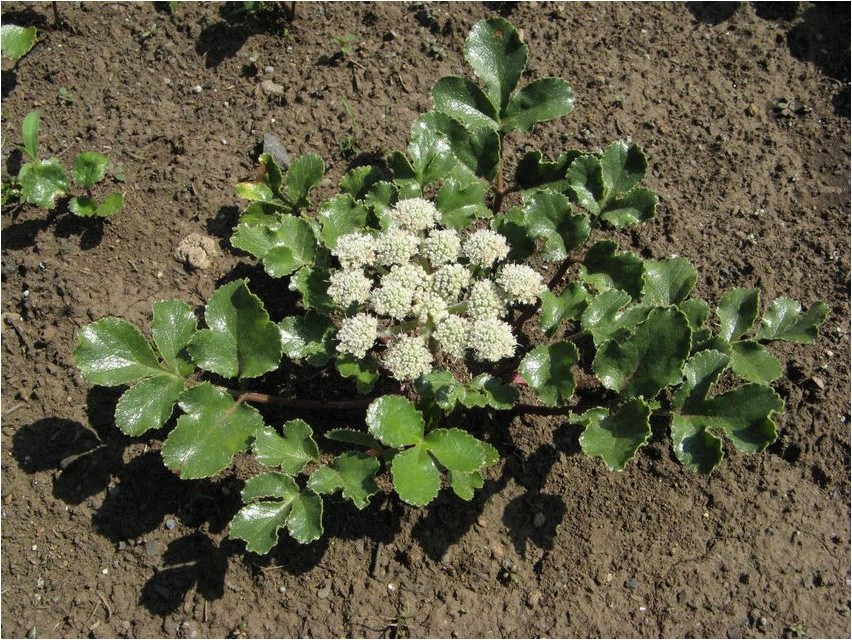
Glenia littoralis is one of the plants of the family called Umbellaceae, and in Latin the name of this plant will be as follows: Glenia littoralis Fr. Schmidt ex Miq.
As for the name of the seaside family, in Latin it will be: Apiaceae Lindl.
Description of Glenia Primorica
Glenia seaside is a perennial herbaceous plant that is endowed with a long root that is relatively thick, and its thickness will be about half a centimeter to one and a half centimeters. The stems of this plant are thick, their height will be about ten to forty centimeters. Such stems are simple or slightly branched, and also densely or curly tomentose. Such stems are endowed with reddish hairs, as well as one or three leaves, however, sometimes they are also leafless. Several basal leaves of this plant are double-pinnate, and sometimes they may also have more developed lower primary lobes. The leaves of Glenia maritaria will be bare on the upper surface, and below they are tomentose-pubescent, while the stem leaves are endowed with a base expanded into the sheath. It is noteworthy that sometimes the stem leaves of this plant are reduced to a sheath. There will be about one to five umbrellas, they are located at the ends of the stems and branches, they will be about four to ten centimeters in diameter, and they are also endowed with unequal felt-pubescent rays in the amount of about ten to sixteen pieces. The fruit of Glia maritaria is broadly ovoid, its length will be about six millimeters, and its width will be approximately four millimeters.
The flowering of this plant begins in June and will last until July. Under natural conditions, this plant can be found in the Far East, namely in Primorye, Sakhalin and the Kuril Islands. For growth, this plant prefers sandy ridges, seashores, and also thickets of rose hips.
Description of the medicinal properties of Glenia Primorica
Glenia seaside is endowed with quite valuable healing properties, and it is recommended to use the roots of this plant for medicinal purposes.
The roots of Glenia maritima contain both polyacetylene compounds and the following coumarins: marmesin, scopoletin, aloisoimperatorin, 7-0-beta-genciobiside osteol, imperatorin, bergapten, psoralen, cnidimin, xanthotoxol, isoimperatorin, xanthotoxin and 8-geranyloxypsoralen. It is noteworthy that the aerial part of this plant contains essential oil. The fruits of this plant contain essential oil, as well as the following coumarins: imperatorin, bergapten and pterin. In addition, the fruits of Glia maritaria also contain fatty oil, which contains linoleic, palmitic, petroselidic and petroselinic acids.

It should be noted that the sum of coumarins in this plant will have quite effective antitumor activity. As for Chinese and Japanese medicine, here preparations based on this plant are quite widespread. Here, Glenia maritima is used as an antipyretic and diaphoretic intended for the treatment of a variety of colds, as well as rhinitis. In addition, such drugs are also effective as sedatives and anticonvulsants, which should be used for paralysis, and in addition, this drug can also be used as a hypotensive, analgesic, and also for hypertension and diabetes. The leaves of this plant are used as a seasoning.