Pulmonary Gentian
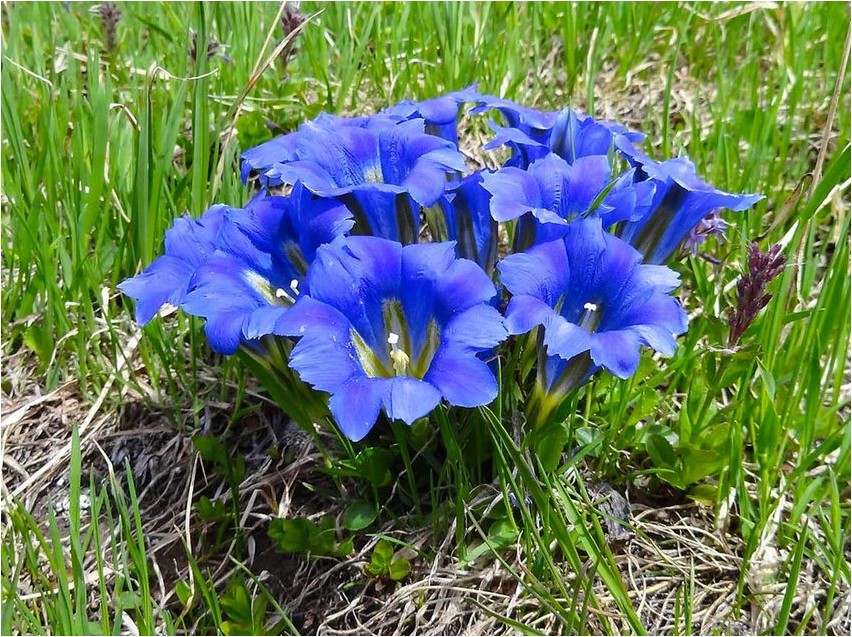
Pulmonary gentian is a member of the Gentianaceae family. Its Latin name is Gentiana pulmonanthe L.
As for the name itself, the Latin name is Gentianaceae Juss.
Description of Pulmonary Gentian
Pulmonary gentian is a perennial herbaceous plant, growing approximately ten to sixty-five centimeters tall. These plants have a fairly thick rhizome bearing scaly leaves and several flowering stems. The leaves of Pulmonary Gentian are opposite and linear-lanceolate, obtuse, and have recurved margins. The flowers are quite large, borne singly in the axils of the uppermost leaves, and clustered in a raceme toward the top. These flowers are a bright azure shade. The flowering period of the pulmonary gentian begins in July and ends in August. In the wild, this plant can be found in Ukraine, Belarus, Western and Eastern Siberia, Central Asia, and the European part of Russia. It prefers forest edges, forest clearings, meadows, marsh edges, forests, shrubs, and river and lake shores, from lowlands to mid-mountain zones. The pulmonary gentian can grow both sparsely and in groups.
Description of the medicinal properties of the pulmonary gentian
The pulmonary gentian has quite valuable medicinal properties, which are explained by the beneficial elements found in the plant itself. The plant contains carbohydrates and related compounds: glucose, fructose, gentiobiose, and sucrose. Gentianin and gentiopicrin are found in the roots of this plant, and gentiopicrin has been found in the grass. Moreover, the stems and leaves of gentian lungwort contain flavonoids.
Infusions, as well as decoctions and tinctures, prepared from gentian lungwort are recommended for various respiratory infections, hemeralopia, and lung diseases. This remedy is also used as an antispasmodic, and when applied topically, it is used for bruises. It should be noted that a decoction of this plant’s herb is very effective for intestinal and stomach ailments, as well as intestinal and gastric colic, tinnitus, scrofula, nervous system disorders, menorrhagia, and as an obstetric aid.
A decoction and infusion of gentian pulmonary rhizomes should be used as a means to stimulate appetite and improve digestion in cases of nervous diseases, gastralgia and gout. This remedy is also effective as an antifever, tonic and anthelmintic. It is noteworthy that it has been experimentally proven that gentianin is capable of having a pronounced effect on the nervous system, as well as exhibiting anthelmintic properties.

As for Tibetan medicine, here an infusion of gentian pulmonary herb is used for rinsing with sore throat. At the same time, it is recommended to drink an infusion of the flowers of this plant for various nervous diseases: neuroses and neurasthenia, and a decoction prepared with milk can be used as an anticonvulsant. In addition, a decoction of gentian pulmonary herb is also used in veterinary medicine as a general tonic. It is noteworthy that the flowers of Gentian pulmonata can color the fur blue.
For gout, it is recommended to use the following remedy: to prepare it you will need to take one tablespoon of crushed rhizomes per glass of water, this mixture should be boiled for ten minutes and left to steep for one hour. Then this mixture is brought to the original volume with boiled water and filtered. This remedy is taken one-fourth of a glass three times a day before meals.
GENTIAN PULMONARY || Benefit quality application





