Gray clematis
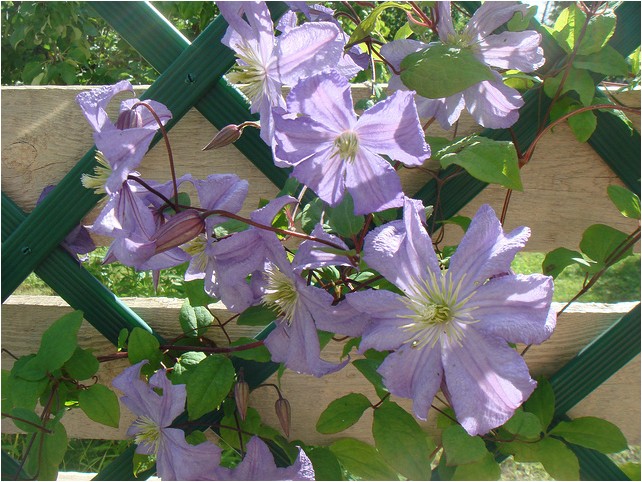
Clematis glauca is one of the plants of the family called Ranunculaceae; in Latin the name of this plant will be as follows: Clematis glauca Willd.
As for the name of the gray clematis family itself, in Latin it will be: Ranunculaceae Juss.
Description of the gray clematis
The gray clematis is a shrubby plant; the stem of such a plant is climbing and ribbed, sometimes it can be colored in reddish-purple tones. Such a stem will be either almost bare or short-haired, and its length will fluctuate between two and five meters. The leaves of this plant are painted in blue-green tones, they are pinnately dissected and endowed with rather long and thin petioles that will curl around in a ring or cling to a support. The primary lobes will be located on long thin petioles. The leaves of clematis glaucous are entire, elliptical or ovoid, and in addition they can be longer, lanceolate-linear, while less often the lobules of such leaves will be three-cut or tripartite into lanceolate or ovate lobes. The flowers of this plant are colored greenish-brown or yellowish-brown, and often they will be reddish on the outside. Such clematis flowers are found in a small paniculate inflorescence and in the axils of the leaves, while the fruits are pubescent and flattened. The flowering of gray clematis occurs in the month of July, while the ripening of the fruits of this plant will occur in the month of August.
Under natural conditions, this plant is found in Central Asia, in the Angarsk region of Eastern Siberia, as well as in the following areas of Western Siberia: in the southeast of the Irtysh region and in the Altai region. For growth, this plant prefers coastal thickets, meadows, places along river banks, places among steppe shrubs, gorges in rocky belts and on rocky slopes.
Description of the medicinal properties of clematis
Blue clematis is endowed with very valuable healing properties, and it is recommended to use the above-ground part of this plant for medicinal purposes. The presence of such valuable healing properties should be explained by the content of alkaloids and saponins in the aerial part of this plant, while fatty oil will be present in the fruits of clematis.
As for traditional medicine, this plant is quite widespread here. Gray clematis is recommended for use for arthritis, chronic rheumatism, and also for aching joints. For this purpose, it is recommended to use a decoction based on the blue clematis, prepared from about ten to fifteen grams of the herb of this plant. It is important to note that in order to achieve the greatest effectiveness when taking such a medicinal product, it is recommended to strictly follow all the rules and regulations for the preparation of such a medicinal product based on this plant. For abscesses, it is also recommended to use a very effective medicine based on clematis glaucosa: to prepare such a remedy you will need to take about ten to fifteen grams of crushed grass. Oil should be added to such a mixture, after which this healing mixture is left to cool and then used as an ointment. For scabies, the leaves and bark of this plant are used: such elements of clematis should be boiled over low heat, after which this remedy is used in the form of baths. It is important to remember that in this case, the primary role is played by strict adherence to all the rules for preparing such a healing remedy based on clematis.


