Lily of the Valley
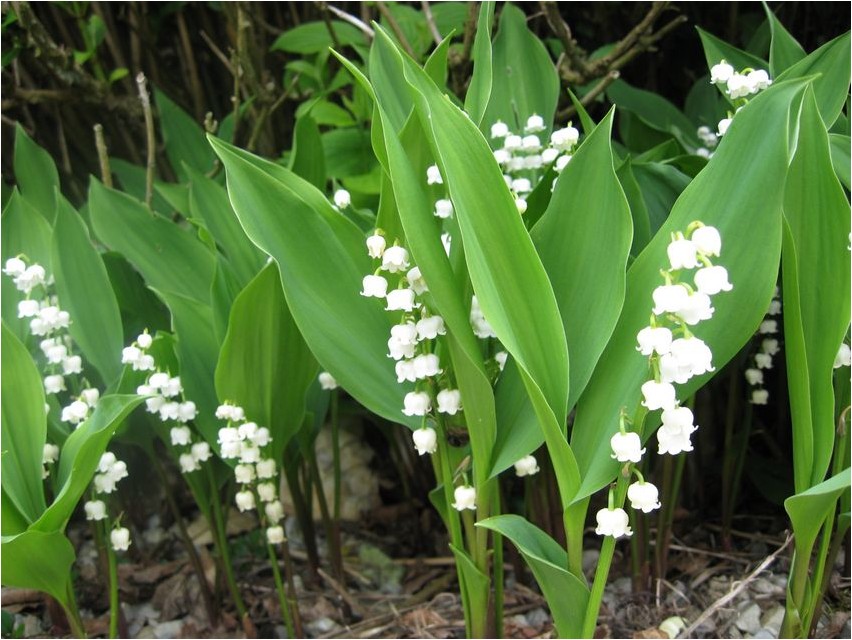
Lily of the Valley is a member of the lily family. Its Latin name is Convallaria majalis L.
The family name of Lily of the Valley itself is Liliaceae Juss.
Description of Lily of the Valley
Lily of the Valley is a perennial herbaceous plant with a long, creeping rhizome and roots. Its flower stalk is relatively short, extending upward from the rhizome itself. Two or three large, elliptical leaves encircle the stem. The stem bears five to ten white flowers, shaped like bells and with six teeth along the edges. The fruit is a red berry. Lily of the valley blooms from May to June. In the wild, this plant is found in Eastern Siberia, the Caucasus, the Far East, Crimea, and European Russia. It prefers floodplain meadows, forests, and areas between shrubs.
Description of the medicinal properties of lily of the valley
Lily of the valley has very valuable medicinal properties. Both the leaves and flowers of this plant are used medicinally, and a combination of both is also acceptable. The rhizomes are rarely used. It is noteworthy that the flowers are the most valuable part of this plant in terms of biological activity. Such valuable medicinal properties can be attributed to the presence of asparagine, essential oil, starch, steroidal saponins, the alkaloid maylin, citric and malic acids, as well as the following glycosides: glucoconvalloside, convallatoxone, convallatoxin, and convalloside. This plant also contains other cardiac glycosides. The leaves of lily of the valley contain vitamin C, and the flowers of this plant contain lycopene and farnisol.
It is noteworthy that the cardiac glycosides of this plant have a tonic effect on the cardiac system, but they do not have cumulative properties. Lily of the valley-based preparations are most often recommended for use in combination with hawthorn and valerian-based preparations for cardiac neurosis.
It is recommended to take a tincture based on lily of the valley two or three times a day, approximately fifteen to twenty drops. Based on this plant, a drug called korglykon was created; this product is an ampoule preparation that is intended for intravenous administration. At the same time, one ampoule contains a very small content of kirglicon itself. It should be noted that it is recommended to administer this remedy extremely slowly, in ten to twenty milliliters of a twenty percent glucose solution.

A drug called convaflavin is also created on the basis of this plant; this product is a total flavonoid preparation of the Far Eastern lily of the valley herb. It is noteworthy that such a very valuable healing agent will be endowed with quite effective antispasmodic and choleretic effects. The use of such a very effective remedy based on this plant is recommended for diseases of the biliary tract and liver diseases. This healing remedy should be taken before meals for about three to four weeks, three times a day, two hundredths of one gram. This remedy turns out to be very effective when used correctly.
May lily of the valley
Lily of the valley May lily of the valley