Hebe
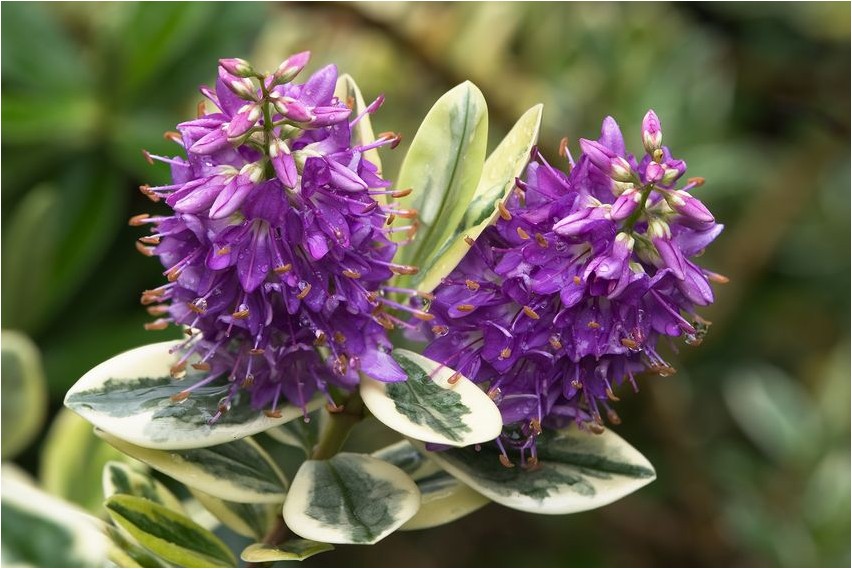
Hebe is a genus of evergreen plants that occur naturally in the southern hemisphere of our planet. Actually, the very name of this plant should be associated with the name of the goddess of youth Hebe, who was revered by the Greeks.
The most common types of this plant are: beautiful hebe, lacquered hebe and subalpine hebe. Beautiful hebe is grown on the Black Sea coast, this plant is quite tall and has large leaves; in central Russia this plant will not be able to withstand winter. Hebe lacquered has very attractive shiny foliage, but hebe subalpine has leaves painted in light green tones.
The Hebe genus is included in the family called plantain, but in some sources the plant is classified as a member of the plantain family.
Among the species of this plant there are also dwarf shrubs. For example, hebe epacrisoides reaches ten centimeters in height, hebe thickleaf – fifteen centimeters, hebe loaf – thirty centimeters, hebe diosmofolia – fifty centimeters, and hebe whitening reaches sixty centimeters. At the same time, among the species of this plant there are also trees whose height is about seven meters.
Care and cultivation of hebe
Hebe is particularly fond of westa, but on particularly hot days the plant will require shade from particularly intense solar radiation, which can cause the hebe to get burned. In the period from October to February, the plant should be provided with a period of rest. However, no matter the weather conditions, the plant will require a bright degree of light and moderate temperatures. In winter, the temperature should be about twenty to twenty-two degrees, but in winter it will be necessary to maintain the temperature within a radius of six to eight centimeters. However, if there is excessive heat, the plant may lose not only its leaves, but also its buds.

As for air humidity, hebe should be sprayed in summer when the temperature is especially hot. Sometimes it is recommended to move the plant to a balcony or to a garden; in such conditions the plant will develop well.
This plant also loves moisture, so in the summer you will need to provide fairly abundant watering. With the onset of the autumn season, it will be necessary to reduce watering; as for the winter period, watering should be carried out only after the substrate has dried. However, you should not allow water to stagnate at the roots of the plant; for this, drainage should also be added.
As for the choice of soil, it should be light and loose. The optimal substrate is a mixture of turf soil, leaf soil, peat soil, and sand. In addition, it is sometimes considered necessary to add a little birch charcoal, as well as fine expanded clay.
If you replant the plant in the spring, you will need to create the following mixture: one part turf soil and sand, and three parts leaf soil. The following substrate is also acceptable: one part of leaf soil and sand, and two parts of clay soil. Young plants should be replanted every year, but adult plants need replanting every two years.
As for feeding the plant, this will require liquid fertilizer intended for ornamental flowering plants. From April to September, this fertilizer should be used once every two weeks. However, before using the fertilizer, you should make sure that it does not contain calcium salts.
Reproduction of this plant can occur both through seeds and cuttings. In addition, it is also important to pinch the plant, which will stimulate its further favorable development.