Caladium bicolor
Caladium bicolor is part of the plant family called Araceae. In Latin, the name of this plant is as follows: Caladium bicolor.
As for the name of the family of this plant, in Latin it will be like this: Araceae.
Description of caladium bicolor
To successfully grow this plant, you will need to provide it with either a sunny light regime or a partial shade regime. It should be remembered that throughout the summer season, bicolor caladium needs abundant watering. At the same time, air humidity should be kept at a fairly high level. The life form of this plant is a herbaceous plant.
It is recommended to grow the plant either in greenhouses, or in winter gardens, or in indoor greenhouses. However, in indoor conditions, two-color caladium is recommended to be placed on western or eastern windows, and in the case when the plant grows on southern windows, additional shading will be required. When a pot with a plant is placed on a windowsill, it will be necessary to ensure reliable protection of the plant from dry air: this seems especially relevant when tubers are growing and the radiators are still working for heating. As for the maximum size of the crop, the height of the bicolor caladium will fluctuate between twenty and forty centimeters.
Description of the features of growing and caring for two-color caladium
For favorable development, this plant will require a transplant, which should be performed approximately starting from the end of February. The tubers of this plant should be planted in new soil. As for the composition of the soil mixture, you will need to take one part of turf soil, two parts of leaf soil and half of one part of sand. The acidity of such soil should be slightly acidic.
It is important to remember that low air humidity is extremely undesirable for this plant. In such situations, drying of the edges of the leaves may occur, and young leaves become extremely unpleasant in appearance. In some cases, this plant may be affected by aphids or spider mites. You should not spray the leaves, due to the fact that in this case brown spots may appear on the leaves.

As for the dormant period, it is recommended to store bicolor caladium tubers in dry sand at a temperature that does not fall below eighteen degrees. It is worth noting that throughout this entire period of time the plant will not need to be watered. Around the end of September, the leaves of the bicolor calandium will begin to dry out, after which the leaves will begin to fall off. This period of rest will last until the end of February.
Reproduction of calandium bicolor can occur either by offspring or by dividing tubers or parts of tubers. It is noteworthy that sometimes it is permissible to propagate this plant using seeds. As for propagation by division, such divisions must have one growth bud.
It is recommended to germinate tubers in mini-greenhouses. In this case, the degree of air humidity should be increased when the first leaf appears. Throughout the entire period of leaf growth and until the start of the dormant period, it will be necessary to provide the plant with air humidity of at least seventy percent, which is due to the fact that caladium bicolor is particularly sensitive to low air humidity.
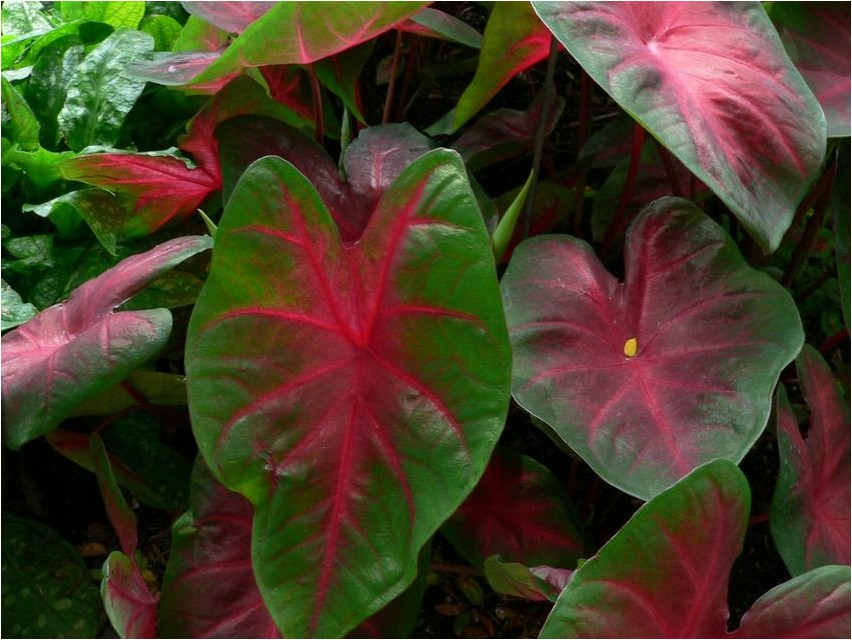
The leaves of this plant are endowed with decorative properties. The length of the leaf blade will be approximately ten to thirty centimeters, and the width will reach ten to seventeen centimeters. The color of plants can be green with red and white spots, as well as red with white pigmentation and green edges.