Grey-green sable grass
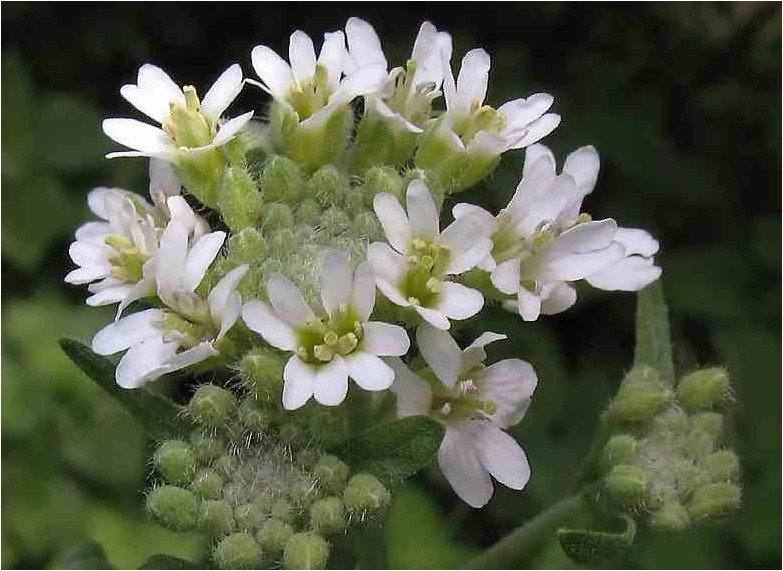
Grey-green sable grass is a member of the Brassicaceae or Cruciferae family. Its Latin name is Berteroa incana L.
As for the family name of grey-green sable grass, the Latin name is Brassicaceae Burnet. Cruciferae Juss.
Description of Grey-green sable grass
Grey-green sable grass is also known by the following common names: white flower, babišnik, ikavka, white borovitsa, white centaury, white centaury, kechegul, kashnik, morkva, forest sable grass, gustikov, sage grass, and chihota. Grey-green sable grass is a biennial, herbaceous, grayish-green, short-pubescent plant that grows approximately twenty to fifty centimeters tall. This plant has a short taproot. Its leaves are alternate and lanceolate, acute and entire, and also sessile. The basal leaves of the grey-green hornwort are petiolate. The flowers of this plant are quite small, with four distinct petals and six stamens; these flowers are white in color. The pistil of this plant has a superior ovary. The flowers of the grey-green hornwort are borne in rather short racemes. The fruits of this plant are oval, bivalved pods, six to nine millimeters long. These fruits have slightly convex valves and are densely pubescent with stellate hairs. The seeds of this plant are round in shape, tuberculate, flattened, and colored brown.
The grey-green hornwort blooms throughout the summer. In the wild, this plant is found in Ukraine, Siberia, European Russia, Central Asia, the Caucasus, Belarus, and the Caucasus. It prefers fallow lands, forest edges, steppes, roadsides, and weedy areas.
Description of the medicinal properties of the sable grass
Sable grass has very valuable medicinal properties, and it is recommended to use the herb and seeds of this plant for medicinal purposes. The herb includes the stems, flowers, leaves, and fruits. It should be noted that the chemical composition of this plant has not yet been fully studied.
The plant has diaphoretic, diuretic, sedative, astringent, and wound-healing properties. An aqueous infusion of this plant is recommended for hiccups and suffocation.

As for traditional medicine, an infusion and decoction of crushed seeds of the gray-green hiccup has become widespread. Such remedies should be used for bites from rabid animals. In the first and second year of life, a fairly effective remedy for children is taking baths from an infusion of the herb of this plant: such a remedy helps against spasmophilia and thinness. An infusion of the flowers of this plant should be used for diarrhea, especially for children. To do this, take one or two tablespoons of this plant and pour one glass of boiling water, after which the mixture is infused. Take the resulting product one tablespoon every two hours. As for the decoction of the whole plant, it is recommended to take this remedy orally for various female diseases, bleeding after childbirth, leucorrhoea, stomach diseases, nervous hiccups and headaches.
For migraines, it is recommended to prepare the following very effective remedy based on Ikotnik grey-green: for this you need to take one tablespoon of dry herb Ikotnik grey-green for one glass of boiling water. The resulting mixture should be infused for an hour or two, after which the mixture is filtered very carefully. Take this remedy one tablespoon three to four times a day.